The Moche Route
The Moche Route
Over 200 km between Trujillo and Chiclayo, the Moche Route reveals adobe pyramids, polychrome frescoes, and royal tombs from a civilization predating the Incas.
Located on Peru's north coast, the Moche Route is a captivating journey. It immerses visitors in the history and culture of one of South America's most influential pre-Columbian civilizations: the Moche people. This tourist route connects several remarkable archaeological sites and museums. It offers a unique glimpse into the lives and traditions of this region's ancient inhabitants. Whether you're an archaeology enthusiast, history lover, or simply a curious traveler, the Moche Route delivers an unforgettable experience, drawing you deep into the glorious past of northern Pérou.
The Moche People
The Moche civilization flourished between approximately 100 and 800 AD on Pérou's north coast. They worshipped a supreme god who reigned above all community members. Beneath this deity, society was organized into several groups in the following hierarchical order:
- Priests
- Warriors
- Artisans
- Merchants
- Fishermen
- Farmers
The Moche are particularly renowned for their advances in:
- Hydraulic engineering
- Social organization
- Monumental adobe architecture
- Artistic works in ceramics and metalwork
The Moche left behind an impressive cultural and architectural legacy, which the Moche Route allows visitors to explore in depth.
Trujillo
Trujillo is often the starting point of the Moche Route. This charming colonial city is home to several archaeological and cultural sites such as Huaca de la Luna and Huaca del Sol. It is the capital of the La Libertad region and renowned for its Plaza de Armas, colorful colonial buildings, and proximity to some of the most important historical sites of Moche culture.
Huacas del Sol y de la Luna
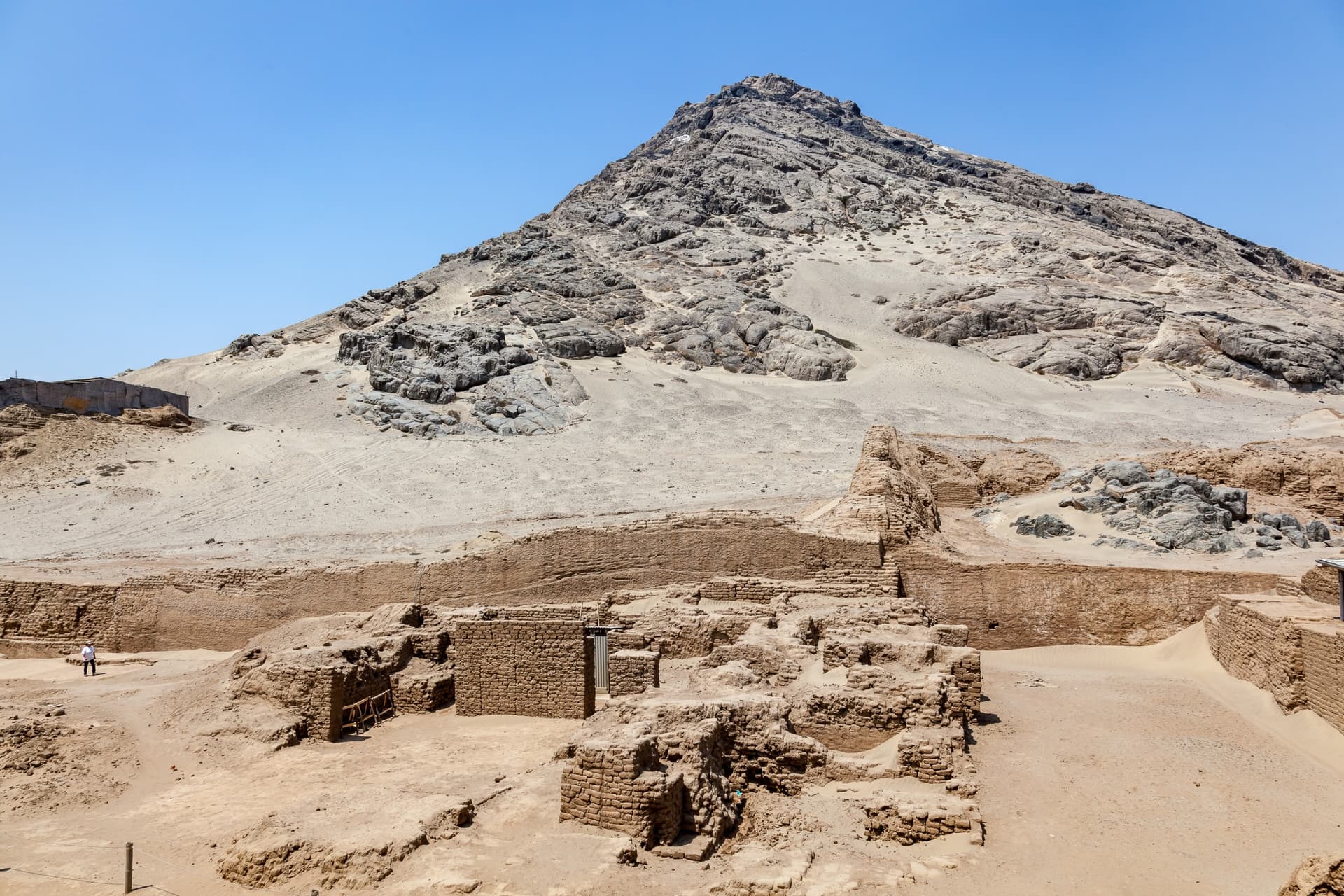
Located about thirty minutes by car from Trujillo, the Huacas del Sol y de la Luna are two of the most emblematic archaeological sites of Moche culture.
The Huaca del Sol, the larger of the two, was likely an administrative and political center. It measures approximately 30 meters in height, 160 meters in width, and 357 meters in length. Many terraces are visible at its rectangular base. It is important to note that this huaca is currently fragile, as it was built in adobe. Therefore, it cannot be visited. Nevertheless, travelers have the opportunity to view it from a distance.
In contrast, the Huaca de la Luna is accessible to visitors. It served as a religious and ceremonial center. It is located 500 meters from the first. This huaca extends 87 meters and stands approximately 20 meters high. It is particularly known for its colorful murals and well-preserved reliefs depicting deities and ritual scenes. Archaeological excavations have revealed numerous objects and human remains, offering valuable insights into the religious and social practices of the Moche.
Furthermore, for those wishing to learn more about these places and Moche culture, a museum is located near the Huaca de la Luna. Between these two huacas, one can also see remains of houses, avenues, alleyways, and plazas.
Chan Chan
Located 5 kilometers from Trujillo, Chan Chan (Sun-Sun) is the largest pre-Columbian adobe city in the Americas and a UNESCO World Heritage Site since 1986. Although this location is primarily associated with the Chimú civilization (11th to 15th centuries AD), it also offers insight into Moche influence on subsequent cultures.
Chan Chan is a vast complex of palaces, plazas, and temples, all built from adobe. It also contains the remains of approximately ten fortified citadels. The walls adorned with relief patterns depicting fish, birds, mythological and geometric figures testify to the region's artistic and cultural wealth. The high-relief sculptures were created using cactus juice, shells, water, and mud.
A visit to this city is an essential stop on the Moche Route, allowing you to understand the continuity and cultural evolution of Peru's north coast. Visiting the museum located within the site provides further details about the Moche and Chimú civilizations.
El Brujo
Another major site on the Moche Route is the El Brujo archaeological complex, situated approximately one hour's drive north of Trujillo. It was likely a ceremonial center of the Moche civilization. El Brujo is celebrated for its pyramids, colorful reliefs, and well-preserved mummies.
Three main monuments comprise the site:
- Huaca Prieta: It resembles an oval hill built from rocks combined with ash remains and debris. This is why it was nicknamed Huaca Negra. It was a location where farmers of the pre-ceramic Andean period created stones using underground mud.
- Huaca Cortada: Created during the Moche period, it features a pyramidal structure enhanced by various tiered platforms. This huaca is characterized by ornamental friezes of fish painted in yellow, gray, black, white, and red.
- Huaca Cao Viejo: It features a central rectangular plaza with numerous tiered levels. This huaca also contains various upper spaces characterized by murals and polychrome frescoes.
Moreover, it was in the Huaca Cao Viejo that the mummy of the Señora de Cao, or Lady of Cao, was discovered. She was a Moche ruler who lived approximately 1700 years ago and reigned in the Chicama valley. The Lady of Cao held significant religious, military, and political roles. Some parts of her body displayed traces of geometric and zoomorphic tattoos reserved exclusively for high-ranking individuals and priests during this era.
Her discovery was revolutionary, revealing details about the role of women in Moche society and the funerary practices of the time. The Cao Museum, located nearby, displays numerous objects found at the site across its seven rooms, along with detailed information about the Moche. Visitors can also view the mummy of the Señora de Cao adorned with precious jewelry and textiles.
The Royal Tombs of Sipán Museum
Located in Lambayeque, the Royal Tombs of Sipán Museum is one of Pérou's most important museums. It houses discoveries made at Huaca Rajada, where the tomb of the Lord of Sipán, a Moche leader, was uncovered. The tomb contained an incredible wealth of objects in gold, silver, and copper, ceramics, textiles, and musical instruments characteristic of Moche civilization.
The Royal Tombs of Sipán Museum is designed to replicate the experience of archaeological discovery. The exhibitions are organized to guide visitors through the different layers of the tomb. The displayed artifacts offer an unparalleled glimpse into Moche life and beliefs.
Túcume
The Moche Route often concludes with a visit to the Túcume archaeological complex, also known as the Valley of Pyramids. This site is located in the Chiclayo region, approximately 18 km north of Ferreñafe. This destination is home to 26 adobe pyramid structures.
These pyramids were built by the Moche, Lambayeque, Sicán peoples, and later used by the Chimú and Incas. Once, they certainly served as craft workshops, cemeteries for the elite, dwellings, and temples.
This site offers a panoramic view of the pyramids and surrounding region from the Cerro Purgatorio hill. It is possible to climb some of them for a unique perspective. Additionally, the museum located nearby can be visited. Its main characteristic is that it was built with period materials such as carob, adobe, clay, and reeds. Lambayeque, Chimú, Inca, and colonial artifacts are displayed there. In September, shamans celebrate annual rites at the site.
Want to discover this destination?
Our local advisors design your tailor-made trip.