Karajia
Karajia
Seven anthropomorphic Chachapoya sarcophagi watch over the valley from an Andean cliff face in the north. Practical guide to visiting Karajia from Chachapoyas.
Karajia or Carajia lies in the remote and majestic Amazonas region of Perú, in the province of Luya. It is a fascinating destination offering a unique glimpse into Perú's pre-Columbian culture. Known for its impressive funeral statues in the form of sarcophagi, it is an archaeological site that attracts many visitors. An excursion to Karajia is an unforgettable experience, combining adventure, exploration and historical discovery.
Climate
Karajia enjoys a moderate mountain climate with two distinct seasons:
- Dry season: Lasting from April to October with temperatures ranging between 18 to 25°C during the day. However, nights are cool with temperatures potentially dropping below 10°C.
- Rainy season: Extending from November to March, temperatures are similar to the dry season. However, humidity and precipitation increase significantly. Rainfall is more intense and very frequent, making trails muddy and slippery, and hiking difficult.
Thus, the best time to visit Karajia is during the dry season, as rainfall is rare and weather conditions for hiking are ideal.
The Discovery of Karajia
Karajia was discovered during 1984–1985 by Peruvian archaeologist Federico Kauffmann Doig and tour guide Carlos Torres Mas. They found at this remarkable site 14 sarcophagi sculpted from clay, of which 7 were placed on cliff ledges. These funeral statues date from the 15th century and are silent witnesses to Chachapoya funeral practices.
The Chachapoya Civilization
Meaning "Warriors of the Clouds" in the Sachapuyo language, the Chachapoyas were a pre-Incan culture that flourished between the 9th and 15th centuries in the northern Andes of Perú. Although dominated by the Incas, this people never completely submitted to the invaders. Furthermore, they allied themselves with Spanish colonizers. The Chachapoyas are known for their skills in agriculture, architecture and techniques for preserving the dead.
The Sarcophagi of Karajia
The Karajia site is famous for its 14 "purunmachos" or Chachapoya sarcophagi, of which 7 visible ones are aligned and grouped together. Unfortunately, one of them certainly fell during the earthquake of 1928 and was never recovered. Additionally, some sarcophagi found inside the crevasse had already been desecrated upon discovery.
The "purunmachos" of Karajia are particularly impressive because of their unique design and difficult-to-access location. Indeed, they were placed on cliff ledges at a vertiginous height, over 2,500 meters in altitude. According to researchers, this reflects Chachapoya beliefs in a connection between the deceased and the gods. The sarcophagi were not only tombs, but also symbolic protectors of the souls of the dead. The deceased thus watched over the community from the heights. Furthermore, their high altitude position also suggests that the Chachapoyas possessed advanced transport techniques.
Moreover, the sarcophagi were sculpted from clay and decorated with geometric patterns and human features. Above the head of some, you can see a skull symbolizing a trophy. The faces painted on these funeral statues are broad and flat. The "purunmachos" of Karajia measure approximately 2.5 meters high. Each contains the mummified remains of a member of the Chachapoya elite, often a chief, shaman (priest) or great warrior.
Airplane
Getting to Karajia is not an easy task, but the effort is worthwhile. The site is located near the village of Cruzpata. The nearest city is Chachapoyas, accessible by airplane from Lima.
Bus and Hiking
From Chachapoyas or other major Peruvian cities, it takes several hours by bus to reach the village of Cruzpata. From there, a hike of 1.5 to 2 hours through rugged and mountainous terrain leads to the Karajia sarcophagi. The hike is quite challenging, with steep climbs and sharp descents. Nevertheless, it allows visitors to admire spectacular views of the Peruvian Andes and the surrounding tropical forest.
Attractions and Activities
When visiting Karajia, travelers can also explore other interesting sites in the Chachapoyas region.
The Quiocta Caves
Most excursions to Karajia include a short detour to the Quiocta caves. This is a series of underground chambers approximately 550 meters deep. These caves were surely used as a burial site or cemetery by the Chachapoyas. Apart from ancient bones, you can also see bats.
Moreover, these caverns allow visitors to enjoy a surreal underground landscape with remarkable formations of stalagmites and stalactites. These were created by the flow of water through limestone rock. To visit these caves safely, it is recommended to bring a headlamp and wear boots available at the entrance.
The Fortress of Kuelap
Located approximately 66 kilometers from Karajia, the fortress of Kuelap was discovered in 1843. It is often compared to Machu Picchu. It is one of the most important archaeological sites in Perú. Kuelap is a massive citadel built by the Chachapoyas on a mountain ridge, offering a spectacular view of the surrounding valley.
Furthermore, the Kuelap fortress was also the scene of massacres in the 16th century, shortly after the arrival of Spanish colonizers. The hundreds of skeletons of children, mostly discovered at the edge of the cliff, are proof of this event. According to archaeologists, this carnage was carried out by neighboring tribes in retaliation. Indeed, they accused the city of Kuelap of being complicit with the conquistadors for spreading famine and devastating epidemics.
Located at approximately 3,000 meters altitude, it is characterized by massive platforms stacked upon one another, including:
- The first measures 600 meters in length and about twenty meters in height, oriented along a South/North axis;
- Two others are in terraces and follow the first. These support 400 constructions, most of which have a cylindrical shape;
- Some platforms are decorated with friezes featuring images of birds or eyes running around the building.
To access the fortress, you must follow a path that narrows. At its end, only one person at a time can pass between two narrow walls measuring 20 meters high.
The Gocta Waterfall
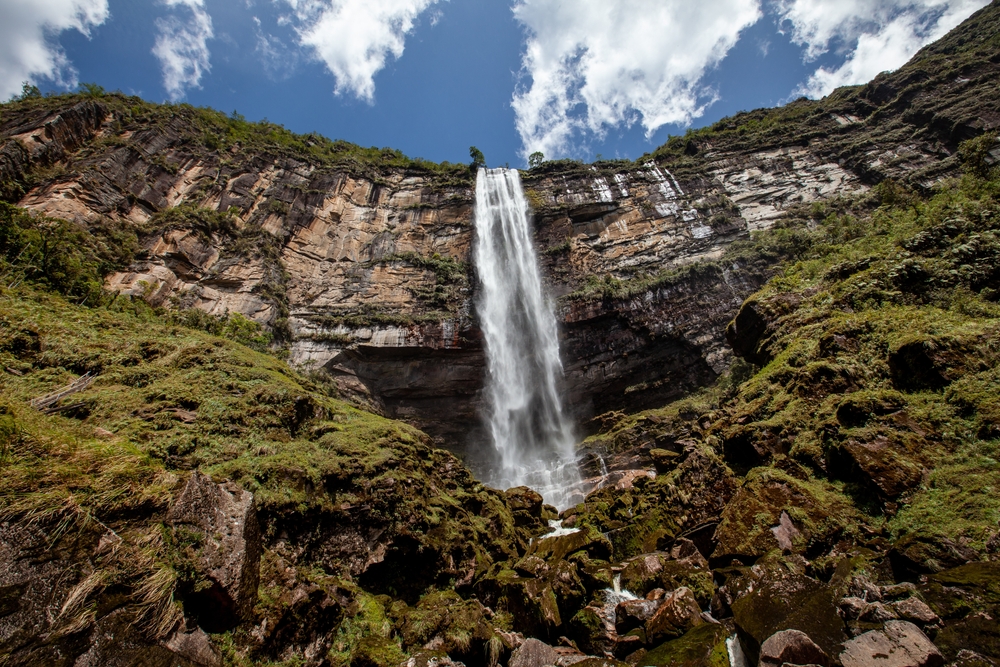
Located approximately 70 kilometers from Karajia, the Gocta waterfall is one of the highest in the world at 771 meters. To reach this natural marvel hidden in the Amazon rainforest, visitors must undertake a hike lasting several hours. By crossing the jungle, visitors can simultaneously admire the diversity of local flora and hear the calls of exotic animals.
The Leymebamba Museum
For visitors wishing to learn more about the Chachapoyas, the Leymebamba Museum is a must-see. It houses a fascinating collection of mummies and artifacts discovered in the region. These findings provide essential historical and cultural context for understanding Chachapoya funeral practices and daily life.
Want to discover this destination?
Our local advisors design your tailor-made trip.