Qeswachaka
Qeswachaka
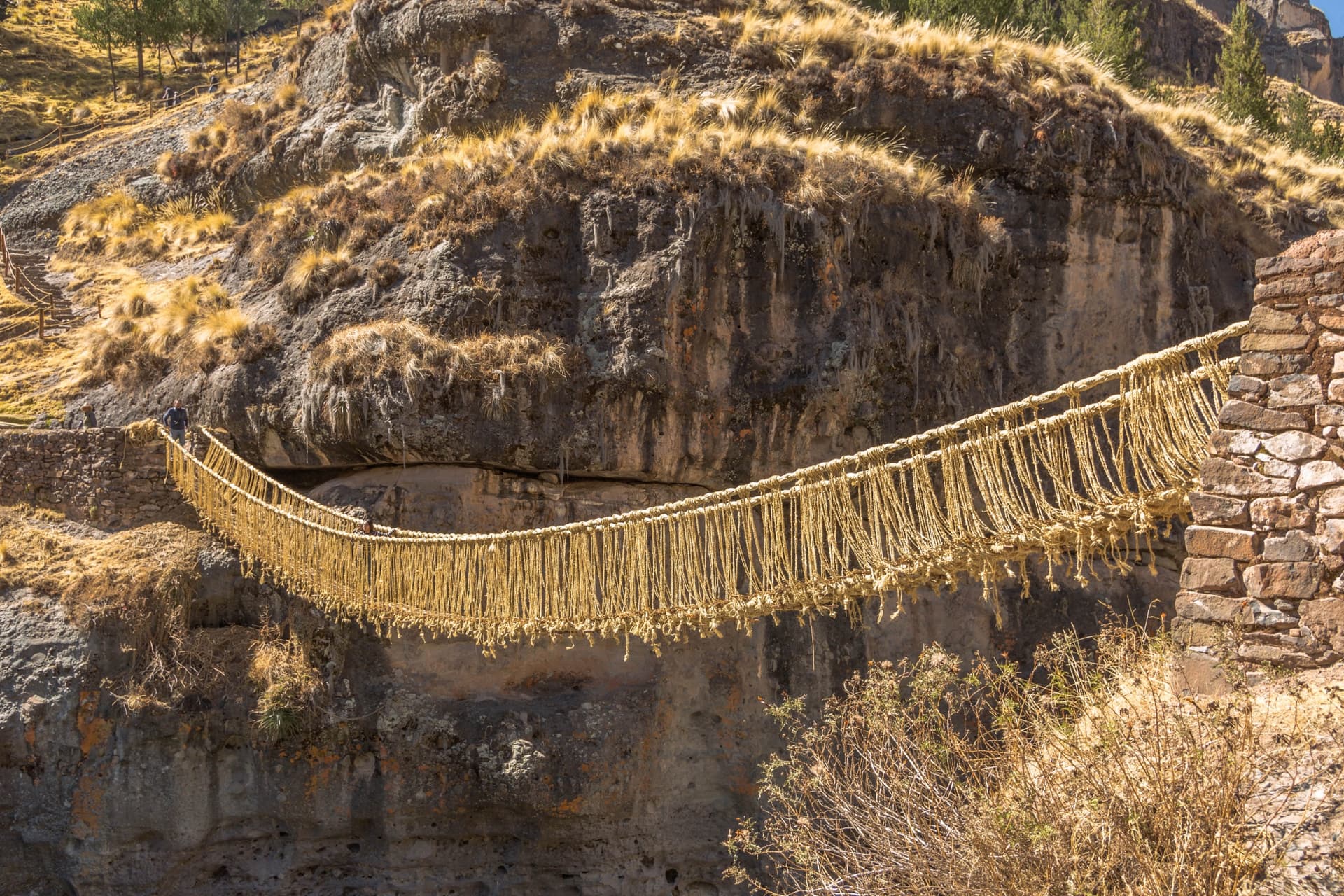
The last suspended bridge woven from rope inherited from the Incas, Qeswachaka is rebuilt each year in June by Andean communities in the Cusco region.
The Qeswachaka bridge (or Q'eswachaka) is one of the last suspended bridges made of woven rope inherited from the Inca period still in use. Located in the Cusco region, Quehue district, Canas province, it spans the Apurímac River approximately 30 meters above the water, at 3,700 meters altitude. Roughly 28 meters long and 1.20 meters wide, it is entirely rebuilt each year by neighboring Andean communities using techniques passed down since the time of Tahuantinsuyu.
Why visit Qeswachaka
The appeal of Qeswachaka goes beyond that of a simple engineering marvel. The bridge embodies a living tradition: its annual reconstruction, recognized as UNESCO intangible cultural heritage in 2013, brings together several villages following a ritual and technical protocol unchanged for nearly five centuries. For travelers, it is an opportunity to witness pre-Hispanic engineering still operational, set within a stark Andean landscape far from standard tourist circuits. The site lends itself to a day excursion from Cusco and complements an itinerary focused on Andean traditions, such as trekking to Vinicunca.
History
Qeswachaka was part of the Qhapaq Ñan, the Inca road network that structured Tahuantinsuyu across thousands of kilometers. Suspended bridges made of plant fibers were essential for crossing the steep valleys of the Andes; this one connected villages separated by the Apurímac. Subject to weathering, the woven ropes degrade quickly: even in Inca times, the structure was restored annually through minka, a collective effort for the benefit of the entire community, ordered by the Inca himself.
The name derives from Quechua: q'eswa (woven rope) and chaka (bridge). In 2009, Peru's National Institute of Culture classified the reconstruction ritual as cultural heritage of the nation. UNESCO inscribed it on the list of intangible cultural heritage of humanity in 2013.
The annual reconstruction ritual
During the second week of June, six communities — Ccollana, Chaupibanda, Huinchiri, Quehuele, Choccayhua and Pelcaro — gather to completely rebuild the bridge in four days. The practice has persisted for nearly five centuries, even as other routes now connect the villages.
Ceremony and offerings
Before any construction, a Paqo (Andean priest) conducts a ritual directed to Apu Quinsallallawi and Pachamama. The offering includes coca leaves, food, fetal llamas, a lamb's heart and incense. A sacred fire is lit and the purifying smoke circulates from hand to hand to seek protection from the deities over the course of the work.
Day 1: material collection
Communities harvest q'oya ichu, a fibrous Andean grass from high altitude. The straw is cut, dried then woven into fine ropes (soguilla) by women and children, under the supervision of a chakaruwak, the specialist responsible for the weaving.
Day 2: preparation
Each village brings the agreed-upon ropes, 38 meters long. Men twist them in the same direction by pulling on a rope, a lengthy operation that makes the fibers more supple. The final cables are distributed as follows: 4 thick ropes for the base and rails, 2 for handrails, 6 for the framework.
Day 3: construction
The men spread out on either side of the river. The old ropes are removed, the stone pillars — anchor points — prepared, then the main cables stretched across the Apurímac and fixed. Secondary ropes then form the floor and railings. According to tradition, women must not approach during this final stage: the bridge is said to belong to the river's mermaids, who are jealous of womankind.
Day 4: completion and celebration
The chakaruwak secure the last ropes while the structure from the previous year is dismantled and abandoned to the current. The two teams meet in the center, lay down mats, and when the final rope is fixed, they let out the ritual cry "Haylly Q'eswachaka" that marks the rebirth of the bridge. Music, traditional dances, shared meals and commercial exchanges between villagers follow. Crossing is then permitted, limited to four people simultaneously for safety reasons.
When to visit
Two visiting approaches coexist. To witness the ritual, aim for the second week of June, when the reconstruction takes place over four consecutive days. For the rest of the year, the bridge remains accessible and passable, in a much quieter setting. The dry season (May to September) offers the best road and visibility conditions; the rainy season (December to March) can complicate access by trail.
How to get there
The site is located approximately 4 hours by road from Cusco (sometimes longer depending on the condition of the final trail). Two options:
- On an organized tour: several agencies in Cusco offer day trips including transport and a guide. This is the simplest option, especially during the ritual period.
- Independent travel: bus from Cusco to Combapata, then a shared taxi to Quehue, and finally a local vehicle for the last 20 minutes to the bridge.
Practical information
- Altitude: 3,700 m. Prior acclimatization in Cusco is recommended.
- Fee: modest entrance fee collected by local communities on site.
- Duration of visit: allow 1 to 2 hours on site outside the ritual period, a half day to a full day during reconstruction.
- Equipment: warm clothing (frequent wind), sun protection, closed-toe shoes, water, cash in soles (no ATM).
- Crossing: permitted in groups of a maximum of four people.
Combining with attractions in the region
Qeswachaka integrates well into a circuit around Cusco blending Inca heritage and high-altitude landscapes. Within varying proximity, you'll find Vinicunca (the mountain of seven colors), the ceremonial site of Q'enko on the outskirts of Cusco, or the Maras salt ponds in the Sacred Valley.
Frequently asked questions
Frequently asked questions
Include Qeswachaka in your journey
To incorporate the Qeswachaka bridge and its Andean traditions into a custom itinerary, explore our ideas for travel to Pérou.
Interested in this visit?
We can include it in your personalised itinerary.