Puya Raimondi
Puya Raimondi
Queen of the Andes, Puya Raimondi is a giant plant endemic to Peru that flowers only once in its lifetime, between 3,200 and 4,800 m altitude.
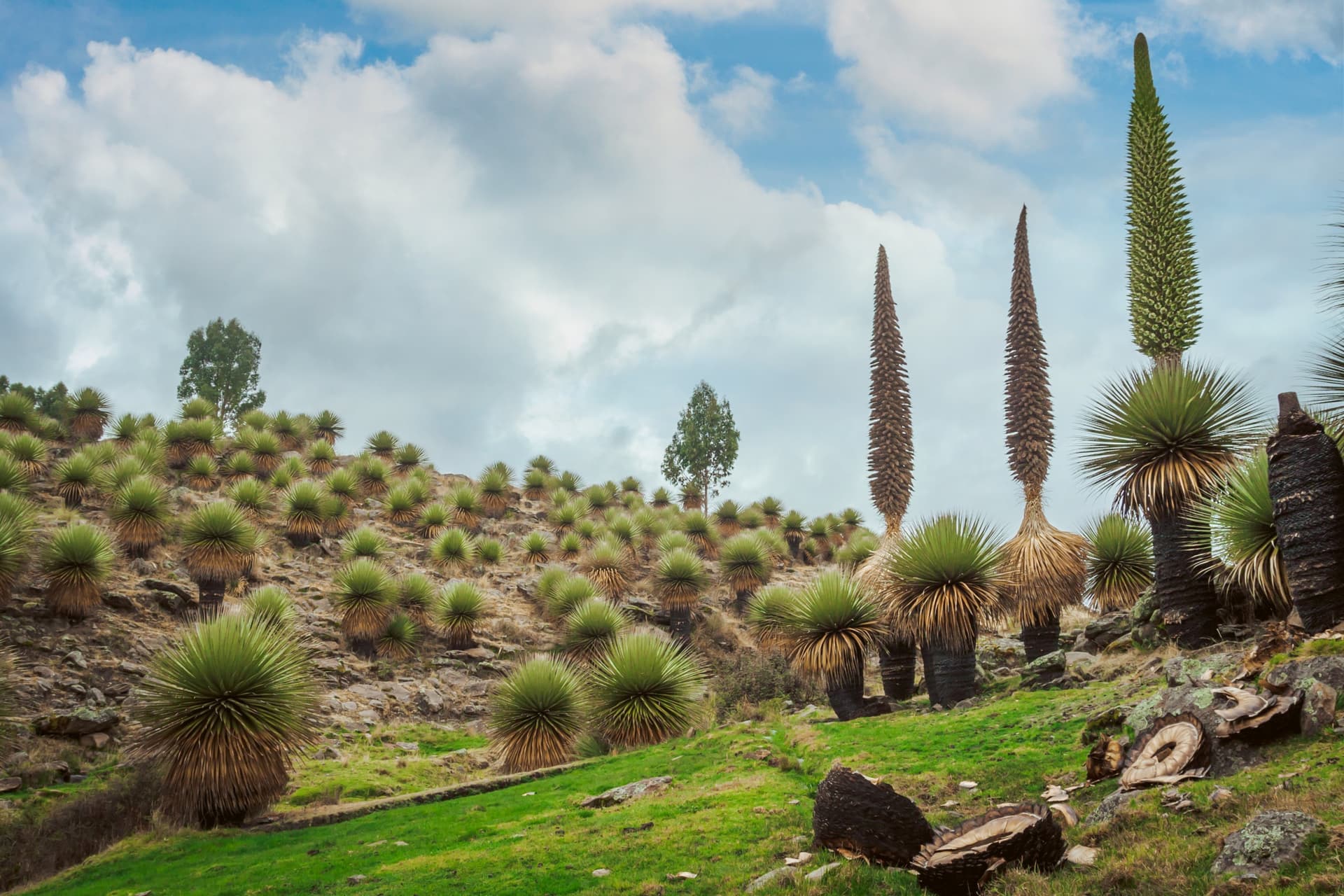
Puya Raimondi is a giant plant endemic to the high Peruvian Andes, growing only between 3,200 and 4,800 meters altitude. Nicknamed Queen of the Andes, also called Titanka in Quechua or "amorous death" by some Andean communities, it can reach 10 meters in height during its single flowering. It belongs to the Bromeliaceae family and represents one of the most singular plant species on the South American continent.
Why come see Puya Raimondi
Observing a flowering Puya Raimondi is a rare event. This hapaxanthic (or monocarpic) plant flowers only once in its lifetime, after 60 to 100 years of existence, then dies. Its flowering spike can reach 9 meters and bear up to 20,000 flowers, making it one of the largest inflorescences in the plant world.
Beyond the botanical record, Puya Raimondi embodies extreme adaptation to Andean conditions: nocturnal cold, poor soils, intense sunlight. Its presence shapes a microecosystem where birds and pollinators play a direct role in its life cycle.
History and scientific discovery
The species was named in honor of Antonio Raimondi (1826-1890), an Italian botanist naturalized as Peruvian who devoted much of his life to studying Andean flora. In his work El Perú, he mentions this plant under the name Pourretia gigantea before it was reclassified. The word "puya" comes from Spanish and means pike or sharp point, referring to the rigid spines that border its leaves.
In certain local traditions, Puya Raimondi is associated with ancient legends linked to the cycle of life and death, which earned it the poetic nickname of "amorous death."
What you will observe
A monumental silhouette
At maturity, the plant measures between 5 and 10 meters in height with a diameter of 50 to 80 cm. Its leaves form a dense rosette of 2 to 3 meters in diameter, long, narrow and bordered with sharp denticles. Withered leaves hang along the trunk, creating a very recognizable appearance. The base is covered with scales formed by old leaves, which capture atmospheric moisture.
The inflorescence
The flowering spike, which can reach 9 meters, bears up to 20,000 small tubular flowers grouped in clusters. Flowering occurs on average every 10 to 15 years for a given individual, between June and August. After pollination, the plant produces between 6 and 12 million seeds, fine and lightweight, dispersed by wind. Very few will germinate due to harsh conditions.
Associated fauna
Several bird species frequent Puya Raimondi: the cream-bellied canastero (Asthenes ottonis), the rufous-collared sparrow (Zonotrichia capensis), the black-winged ground-dove (Metriopelia melanoptera). Pollination is notably ensured by the giant hummingbird (Patagona gigas). Curiously, some birds are trapped by the leaf spines; as they decompose at the base of the plant, they enrich the soil. This indirect behavior earns Puya Raimondi the label of protocarnivorous.
When to visit
The most interesting period is flowering, which extends from June to August. It corresponds to the dry season in the Peruvian Andes, which facilitates access to high-altitude sites. Outside this window, you can see adult plants in rosette form, but without the spectacular flowering spike. Since flowering is cyclical (every 10 to 15 years per individual), it is best to inquire locally about areas where multiple plants are flowering in the same year.
Practical information
The main observation site is Huascarán National Park, in the Ancash region. Other areas of the Cordillera Negra, Punta Winchus, as well as the Apurímac and Moquegua regions also harbor populations.
- Altitude of sites: 3,200 to 4,800 m, plan for prior acclimatization of 2 to 3 days in Huaraz.
- Equipment: warm clothing, windbreaker, high sun protection, plenty of water.
- Duration of visit: plan for half a day to a full day depending on the site chosen.
- Guided excursions: excursions from Huaraz are recommended, both for logistics and botanical interpretation.
The species is classified as "endangered" by the IUCN. The main threats are consumption of young plant pulp, collection of stems for heating and construction, as well as pastoral burning. Stay on trails and do not collect anything.
How to get there
The most commonly used gateway is Huaraz, capital of the Ancash region, accessible by overnight bus from Lima (8 to 10 hours drive). From Huaraz, several sites allow observation:
- The Pumapampa / Carpa sector, in Huascarán National Park, accessible by 4x4 or organized excursion (3 to 4 hours drive).
- The Cordillera Negra and Punta Winchus, west of Huaraz, faster to access.
For travelers exploring the south of the country, populations also exist near Cotahuasi (Arequipa region) and in the Apurímac region.
What else to see in the region
Peru lends itself to itineraries combining nature and heritage. After observing Puya Raimondi at Huascarán, many travelers continue to the Cusco region to visit Machu Picchu, passing through the thermal springs of Cocalmayo or the archaeological site of Chachabamba. For an immersion in Andean astronomy, the Cusco Planetarium offers a reading of the sky inspired by Incan cosmologies.
Frequently asked questions
Frequently asked questions
Plan your trip
Want to include observing Puya Raimondi in a broader Andean itinerary? Explore our trips to Peru to build a custom stay combining nature, archaeology, and Andean cultures.
Interested in this visit?
We can include it in your personalised itinerary.