Caral City
Caral City
Located 200 km north of Lima, Caral features six pyramids dating back to 3000 BC, recognized by UNESCO. A practical guide to visiting America's oldest city.
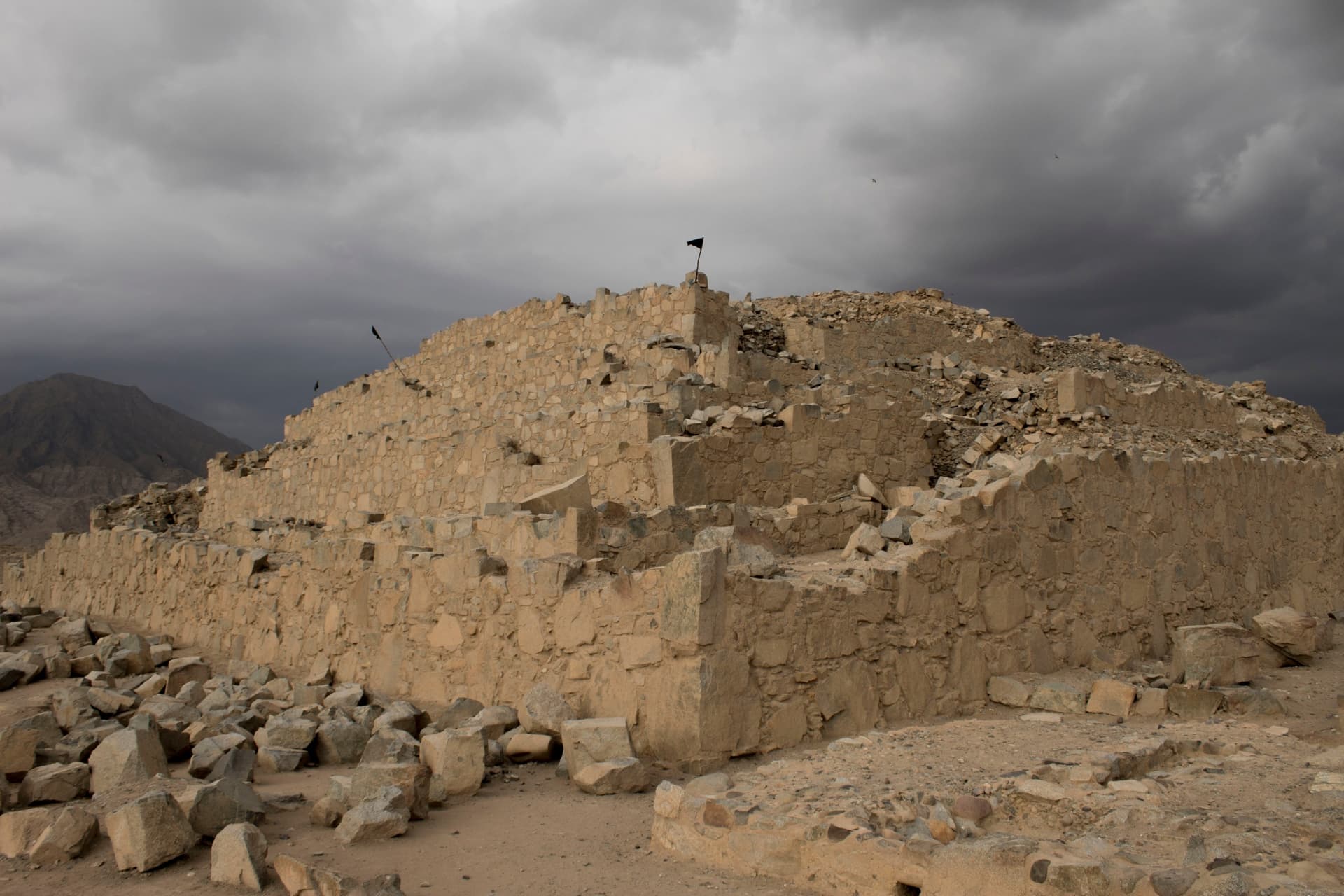
Located 200 kilometers north of Lima, in the Supe Valley, Caral City comprises six stone pyramids, temple platforms with altars, and circular plazas built between 3000 and 1800 BC. Inscribed in 2009 on UNESCO's World Heritage List, the site is considered the oldest city in the Americas and one of the world's earliest urban centers, contemporary with the civilizations of Mesopotamia, Egypt, and Harappa.
Why visit Caral
Caral is not a spectacular site in the Andean sense: no cyclopean walls, no vertiginous vistas. Its value lies in its antiquity and what it reveals about a complex society organized 4,500 years before the height of Inca civilization. Radiocarbon dating makes Caral a direct point of comparison with the first great civilizations of the Ancient World.
The absence of weapon remains across the entire site is one of the most discussed elements among archaeologists: it suggests a society that had not structured its power around warfare, but rather around religion, trade, and irrigated agriculture.
History and rediscovery of the site
German archaeologist Max Uhle inspected the region in 1905 while passing through Asparo, a neighboring coastal village, without discovering Caral. The site, then known as Chupacigarro, awaited a second visit: that of Paul Kosok, who led an expedition in 1949 and published in 1965 Life, Land, and Water in Ancient Peru. His work contains an aerial photograph of the area and sparked scientific interest in Caral.
In-depth excavations began only from 1975 onwards. They revealed planned urbanism, platform temples, a circular amphitheater, and significant artifacts: wind instruments, chikras (bags woven from plant fibers), and quipus, those knotted cords that would later serve the Incas for accounting and administration.
Organization by clans
Caral's society was organized around a curaca, a tribal chief, and leaders of ayllus heading family clans. Caral was one of eighteen colonies recorded in the Supe Valley, and its network extended to neighboring valleys: Huallaga, Haura, and Casma. The volume of construction and the concentration of temples suggest that Caral played a role as a regional administrative and ceremonial center.
The work of Ruth Shady
Peruvian archaeologist Ruth Shady devoted 25 years of research to Caral. Her work, honored with the Order of Merit, enabled international recognition of the site and its inscription on the UNESCO World Heritage List in 2009.
What to see on the site
The 66 hectares declared state property can be explored on foot via a marked circuit. Elements to observe:
- The six flat-topped pyramids made of stone blocks originally transported in reed sacks. Unlike Egyptian pyramids, these are stepped rather than pointed.
- The Great Pyramid, which exceeds 28 meters in height and covers an area comparable to a large sports field.
- The circular amphitheater, a sunken plaza with tiers that likely served for collective ceremonies.
- The Sacred Fire altars, where offerings were burned in hearths ventilated by underground ducts.
- Residential areas built from mud brick, organized around monumental structures.
The inhabitants, estimated at around 3,000 people at peak occupation, cultivated maize, legumes, and sweet potatoes through an irrigation canal system. They wove cotton to produce clothing, shoes, bags, and fish traps. No elaborate pottery or metallurgy have been found, which makes the architectural organization of the site all the more remarkable.
Practical information
The site reopened in October 2021 following Covid-19 closures. Visits are mandatory with an official guide on-site; the tour lasts approximately 1.5 to 2 hours. Bring a hat, water, and closed-toe shoes: the terrain is sandy and shade is scarce. Entrance fees are modest and differentiated for adults, students, and children; opening hours cover the morning and early afternoon, with last entry in the mid-afternoon. Check current conditions before departing.
When to visit
The dry season, from May to October, is most comfortable for visiting Caral: clear skies, sunny days, low rainfall probability. Nights remain cool in the valley. Between December and March, rain is rare in this coastal zone but heat and humidity can make midday walking difficult. Plan a morning visit at opening time to avoid the midday sun.
How to get there
Caral is located approximately 200 km north of Lima, accessible as a day trip. Several options:
- By bus and shared taxi: take a bus from Lima on the North Panamerican Highway heading toward Supe Pueblo. Ask to be dropped at Supe Market, then take a taxi or collectivo (shared taxi) to the site, approximately 25 km inland up the valley.
- By organized tour: the simplest option, with transportation, guide, and lunch included. Plan a full day (early departure, evening return).
- By rental car: exit at Supe on the North Panamerican Highway, then local road heading east to the site.
See in the region
Caral can fit into a broader Peruvian archaeological itinerary:
- Lima, the logical starting point, with its museums and colonial center.
- The ruins of Ollantaytambo, Inca citadel in the Sacred Valley.
- Q'enko, sacred site near Cusco.
- Pampa Cañahuas National Reserve, for a landscape contrast in the altiplano.
Frequently asked questions
Frequently asked questions
Yes, and the gap is substantial. Caral is dated between 3000 and 1800 BC, approximately 4,500 years before the height of Inca civilization to which Machu Picchu belongs (15th century). Caral is contemporary with the Egypt of the pyramids and Mesopotamia.
The guided tour of the site typically lasts between 1.5 and 2 hours. On a day trip from Lima, plan a full day due to travel time (approximately 3 to 4 hours each way).
Access to the site requires an official guide, available at the entrance. This allows for an archaeological reading of the structures, which would otherwise be difficult for an uninformed visitor to interpret.
Excavations uncovered wind instruments, chikras (bags woven from plant fibers), and quipus. The absence of weapons among the recovered objects is a distinctive trait of Caral culture.
A small interpretation center exists near the site and displays key objects from excavations. Major pieces are preserved in institutions in Lima and Supe.
Plan your trip
Caral naturally fits into a cultural tour of Peru combining coast, Andes, and archaeological heritage. Discover our tailored itineraries on our Peru travel page.
Interested in this visit?
We can include it in your personalised itinerary.