The Caral Archaeological Site in Peru
Caral: a majestic archaeological site in the Lima region

The Caral archaeological site deserves increasing attention as a complete city gradually emerges from the sand—and no ordinary city at that! The Caral site has been protected since 2009 and is inscribed on the UNESCO World Heritage List, as it is the oldest city on the entire American continent and one of the oldest in the world.
To place this city in time, archaeologists have estimated it was built 2,600 years ago, around the same era as the construction of the Egyptian pyramids. The Caral archaeological site is located in the Lima region of Peru, approximately 180 kilometers north of the capital.
Additional information about the Caral site

Commonly called the Caral archaeological site, you may also hear it referred to as the Caral–Supe site. Archaeologists estimate that approximately 10,000 people lived within this city, though it actually comprises several distinct archaeological sites forming a large complex. No fewer than forty different locations have been counted, sometimes separated by several kilometers, though roughly twenty are in close proximity to one another, such as Caral, Cerro Blanco, El Molino, Piedra Parada, Cerro Colorado, Miraya, Era de Pando, Allpacoto, Peñico, Pando, Liman Lurihuasi, Pueblo Nuevo, Capilla, Aspero, Chupacigarro, Huacache, and Jaiva.
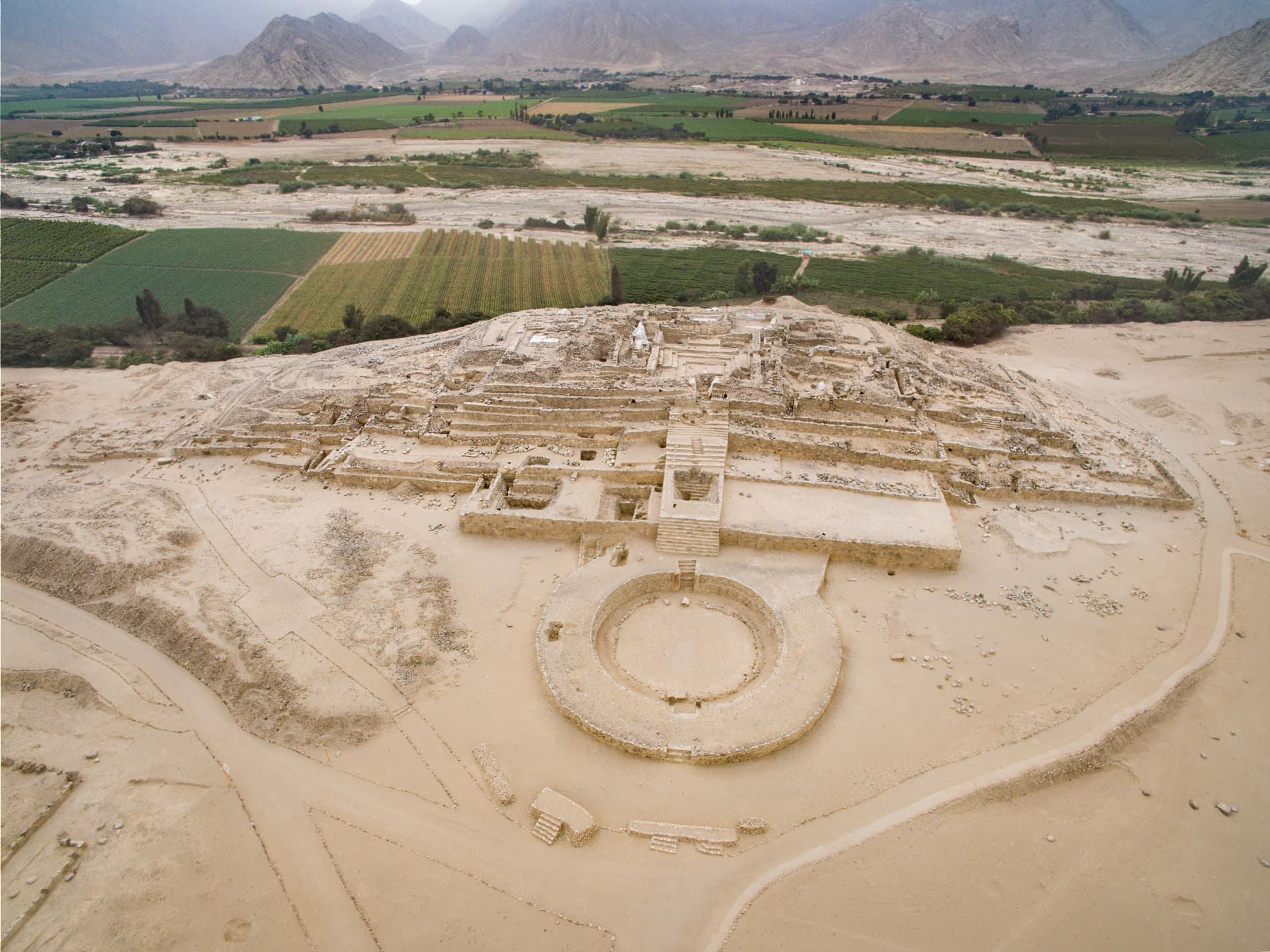
The culture present at Caral demonstrates genuine builders' talents, as in the central area spanning more than 60,000 square meters, there are no fewer than 6 pyramids, surrounded by houses and buildings. A large central plaza allows for a fuller understanding of this unique architectural complex in the Americas. A vast amphitheater is clearly visible and could accommodate hundreds of people. This truly represents the beginnings of a genuine civilization—likely the first developed civilization on the entire continent.

The largest pyramid, to give a sense of scale for the archaeological site, measures 150 meters by 160 and covers an area equivalent to 4 football fields, rising to 18 meters in height. The city of Caral exhibits highly developed social organization among different groups, as well as political and religious structures. The Caral civilization must have developed to this level and in such a complex manner without warfare slowing its progress. Gradually, the different sites are being uncovered from the sand, revealing the history of this vanished civilization. Work initiated in 1990 by Ruth Shady Solis, even though the Caral site had been discovered in 1905, it had remained forgotten due to the lack of treasures and artifacts…