Cruz Del Condor
Cruz Del Condor
An emblematic viewpoint of Colca Canyon, 40 km from Chivay, Cruz del Condor offers views of Andean condors in flight above the canyon.
Cruz del Condor is a viewpoint of Colca Canyon, located approximately 40 km from Chivay. The site owes its reputation to Andean condors that soar above the canyon on morning thermal currents. It is one of the few places in the world where this raptor can be observed in free flight, just meters from the cliff edge.
Why visit Cruz del Condor
The viewpoint combines two rare advantages: a sweeping view of one of the continent's deepest canyons and a regular concentration of Andean condors in flight. The birds take advantage of thermals rising from the canyon in late morning to gain altitude, making observation predictable and accessible to visitors without special equipment.
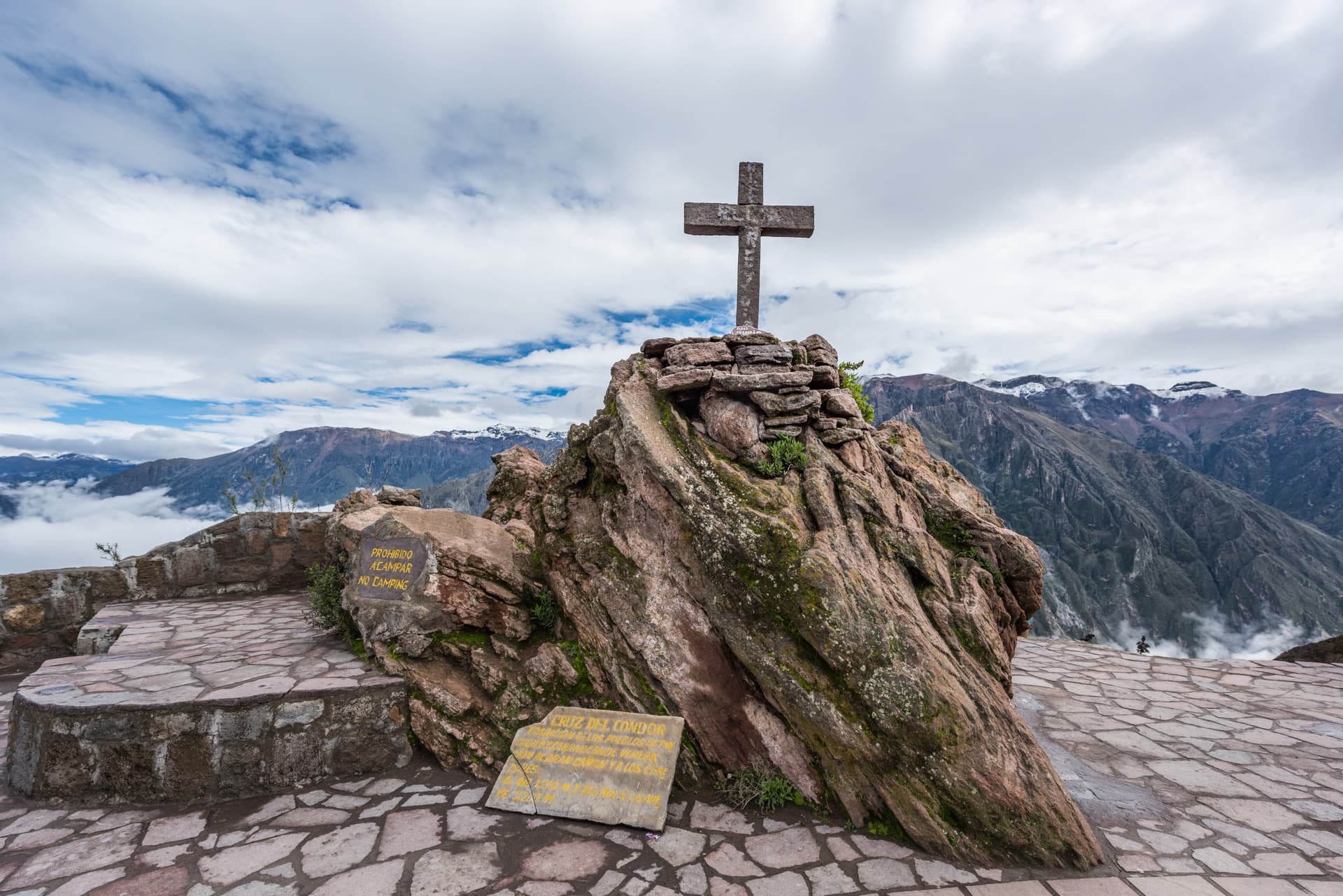
At the summit, a hand-carved stone cross sits on a large boulder and gives the place its name. It remains a photographic landmark for most travelers who stop here.
What to see at the viewpoint
From the platform, several elements structure the panorama:
- Colca Canyon: the viewpoint overlooks the gorge with a vertical drop of approximately 1,200 m between the platform and the river. The canyon itself is among the world's deepest, with more than 3,000 m of depth at its most enclosed section.
- The Colca River: it winds along the valley floor, sometimes barely visible depending on the light. It travels several hundred kilometers before reaching the Pacific under the names Majes and then Camaná.
- The Mismi Volcano: visible opposite the viewpoint on clear days, it reaches 5,547 m. Its foothills harbor one of the recognized sources of the Amazon.
- The stone cross: symbol of the site, it sits on an accessible boulder and remains the gathering point for visitors.
The Andean Condor: emblematic bird
Characteristics
The Andean condor (Vultur gryphus) is the world's largest terrestrial flying bird, with a wingspan reaching 3.20 to 3.50 m. Only the wandering albatross, a pelagic seabird, exceeds it in wingspan (up to 3.70 m). The condor remains the heaviest terrestrial bird, however, weighing 9 to 12 kg with a length of 105 to 130 cm. It also possesses the largest wing surface area of all birds.
Contrary to popular belief, the condor is not a hunter. It is a carnivorous scavenger that feeds on dead animals. This feeding strategy drives it to cover long distances by soaring, which explains its gliding morphology.
Incan and Andean symbolism
In Incan cosmology, the condor was considered a messenger of sky and earth. It carried the souls of the dead to the upper world (the Hanan Pacha) and represented the link between the living and the sacred. Several archaeological sites testify to this importance:
- One of the Nazca geoglyphs depicts a condor with spread wings.
- The Temple of the Condor at Machu Picchu and the Cusco region is dedicated to its symbolism.
- The Yawar Festival stages a ritual combat between a condor (indigenous peoples) and a bull (Spanish conquistadors).
The condor is today the national symbol of Peru, Bolivia, Chile, Colombia, and Ecuador, where it appears on numerous coats of arms. Its name has also been adopted by the German airline Condor, by Peru's Aero Condor, and by the infamous Operation Condor (an anti-guerrilla campaign conducted in the 1970s–1980s in South America).
When to visit
Condors are most active in mid-morning, when thermal currents develop. An early morning arrival maximizes observation chances, which is indeed the window chosen by most excursions.
The dry season (May to November) offers the best conditions: clear skies, optimal visibility over the canyon and Mismi. The rainy season (December to March) makes observation more unpredictable and certain road sections may be affected.
Practical information
- Altitude: the viewpoint sits at approximately 3,800 m. Prior acclimatization in Arequipa (2,335 m) or Chivay (3,600 m) is highly recommended to minimize acute mountain sickness.
- Equipment: bring a windproof jacket and warm layers (mornings are cool), a cap, high-SPF sunscreen, and water.
- Visit duration: allow approximately 1 hour on-site to enjoy the panorama and wait for condors to rise.
- Tourist ticket: access to Colca requires purchase of a regional tourist pass, typically checked at the valley entrance.
How to get there
Access is from Arequipa, the main entry point to the region.
- Tourist van: very early departure from Arequipa (around 3 am), breakfast stop in Chivay, then arrival at the viewpoint mid-morning. This is the most practical option for one to two-day excursions.
- Local bus: from Arequipa's main bus terminal, allow approximately 4 hours to Chivay, then additional transport to reach the viewpoint. A less expensive but longer option.
- With private driver: flexible, recommended if you wish to tailor stops throughout Colca Valley.
What to see nearby
Colca Valley extends well beyond the viewpoint. Several stops complement your visit:
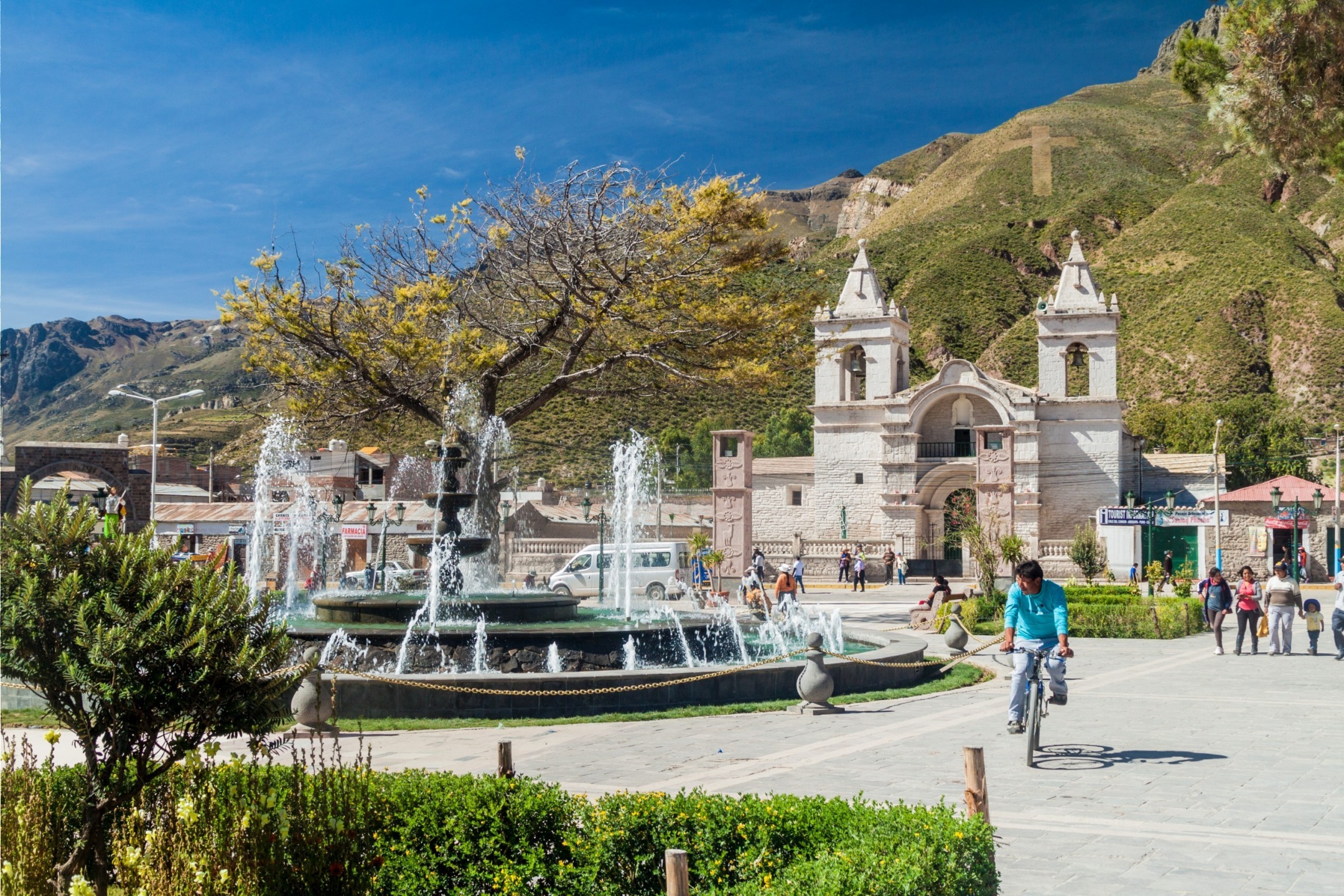
- Chivay, the main village in the valley, logistics hub and thermal gateway (La Calera hot springs).
- The traditional villages of Yanque, Maca, and Pinchollo, with their colonial churches and pre-Incan agricultural terraces still in cultivation.
- The Pampa Cañahuas National Reserve, crossed on the route from Arequipa, where vicuñas and other Andean camelids can be observed.
Frequently asked questions
Frequently asked questions
Integrating Cruz del Condor into your journey
The viewpoint naturally fits into a two to three-day Arequipa–Colca circuit, complementing Cusco, Machu Picchu, and Lake Titicaca. To build a custom itinerary including Colca Valley and condor observation, explore our Peru tours.
Interested in this visit?
We can include it in your personalised itinerary.