The Galápagos Islands
The Galápagos Islands
The volcanic Galápagos archipelago, Darwin's sanctuary, is home to unique endemic wildlife found nowhere else on Earth. A complete guide to preparing your journey.
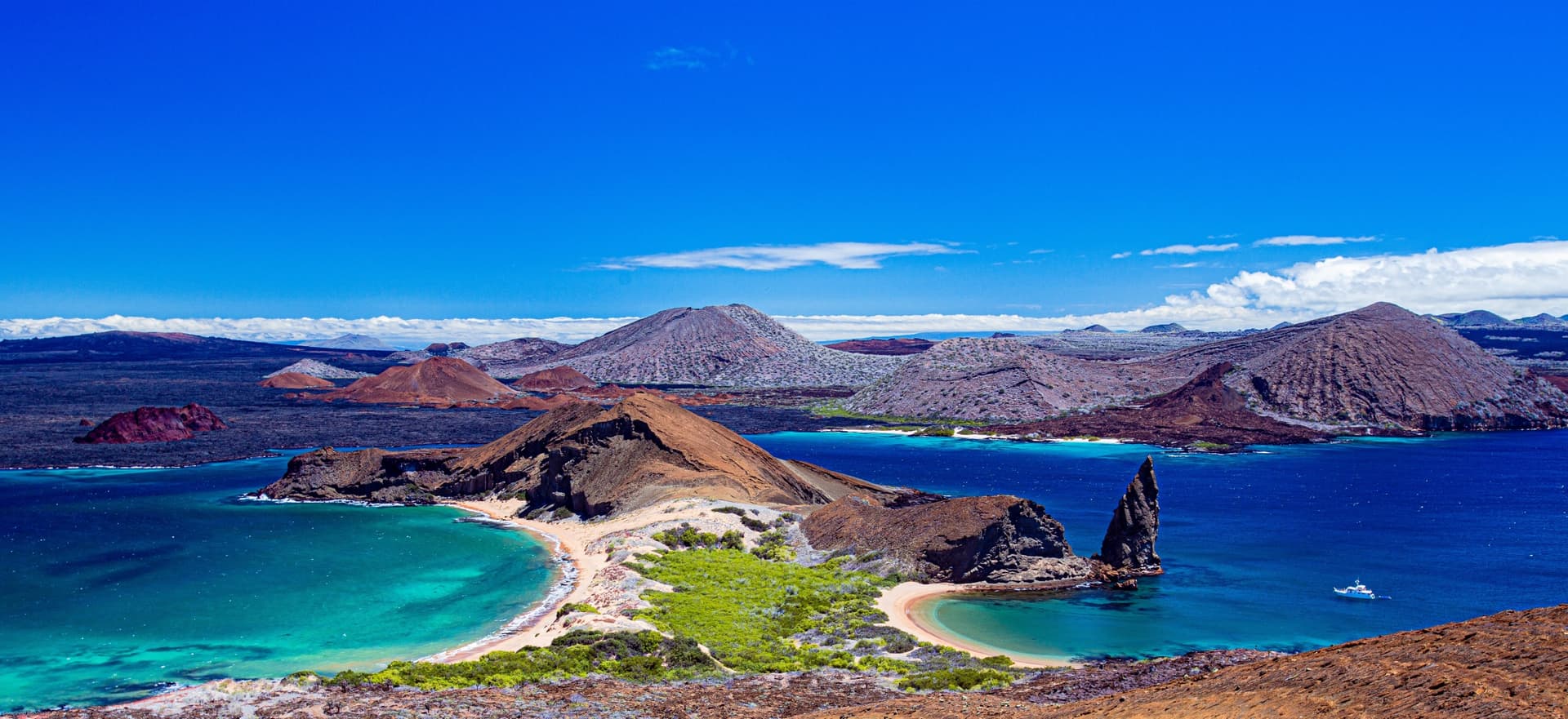
Located approximately 1,000 kilometers west of Ecuador's coast, the Galápagos Islands are renowned worldwide for their exceptional biodiversity. They hold equal significance in the historical development of Charles Darwin's theory of evolution. Comprising 13 large islands, 6 smaller islands, and 107 islets and rocky outcrops, this archipelago presents an extraordinary variety of landscapes. Each ecosystem harbors unique species of plants and animals. These islands form a living laboratory of evolution.
Geography
The Galápagos archipelago is formed by volcanic islands rising from the Carnegie Ridge, an underwater mountain range. The principal islands include Isabela, Santa Cruz, San Cristóbal, Floreana, and Santiago. Each possesses its own distinct geological and climatic characteristics. For instance, Isabela Island, the archipelago's largest, is formed by six volcanoes, some of which remain active. Santa Cruz is known for its wetlands and Scalesia forests.
Climate
The Galápagos Islands experience a tropical dry climate. They do not exhibit the same temperatures as surrounding regions despite their location on the Equator. The climate is primarily influenced by three ocean currents:
- Humboldt (a cold current around 15°C)
- El Niño (a warm current)
- Cromwell (a cold current around 13°C)
Consequently, the Galápagos Islands benefit from two distinct seasons:
- The warm or wet season runs from January to May with temperatures between 23–30°C, accompanied by occasional showers.
- The cool or dry season lasts from June to December with average temperatures between 18–20°C. Also called the Garua season, it is characterized by mist or fog.
History of the Galápagos Islands
While on a mission to Peru for King Charles V, Fray Tomás de Berlanga, the Spanish Bishop of Panama, discovered the Galápagos Islands by chance in 1535. Only from the 1570s onward did the archipelago appear on maritime maps of the era, under the names "Insulae de los Galapagos" or "Las Encantadas."
Subsequently, until the end of the 17th century, the Galápagos Islands served as food and freshwater reservoirs for pirates, buccaneers, and whalers. Later, in 1807, Patrick Watkins settled on Floreana Island and established a trading post for passing vessels.
In 1835, Charles Darwin visited the Galápagos aboard the HMS Beagle. Impressed by the fauna's diversity across the archipelago, he focused his studies on the various finch species. Upon his return and through observations of the variations in animal and plant species across the islands, he developed his theory of evolution by natural selection. This hypothesis was published in his 1859 work, "On the Origin of Species."
The Galápagos archipelago was subsequently colonized rapidly, and in 1892 it was renamed the Colon Archipelago. In 1934, part of the islands was declared a national park. The entire archipelago received this status in 1959. That same year, the Charles Darwin Foundation was established for research and preservation of the Galápagos ecosystems. In 1978, the islands were inscribed as a UNESCO World Heritage Site in recognition of their ecological and scientific importance.
Unique and Exceptional Biodiversity
The Galápagos Islands' biodiversity ranks among the richest and most unique in the world. The majority of fauna and flora are endemic. Here are some animals and plants to discover on each island:
Exceptional Animals
Among the emblematic animals are the giant tortoises. Indeed, the archipelago's name derives from these creatures, called "Galápagos" by the Spanish. Each island is home to a distinct subspecies of reptiles that have adapted to their specific environments. These tortoises can weigh up to 250 kg and live over 150 years.
Marine iguanas are also remarkable creatures to observe during a Galápagos visit. Reaching an average length of 1.20 meters, these lizards feed on marine algae and can dive to depths for over 30 minutes.
Other animal species you may encounter include:
- Sea lions
- Lava lizards
- The world's smallest penguins
- Fur seals
Furthermore, 58 bird species inhabit the Galápagos Islands. Notably, 28 of them are endemic. Visitors may observe:
- Blue-footed and red-footed boobies
- Birds of paradise
- Albatrosses
- Finches with varied beaks
- Frigatebirds
Additionally, the archipelago's marine reserve harbors incredible creatures such as:
- Manta rays
- Hammerhead sharks
- Dolphins
- Humpback whales
Over 300 fish species await discovery in the Galápagos' marine depths.
Magnificent Vegetation
The Galápagos Islands boast remarkable floral diversity. They host over 850 plant species, of which 228 are considered endemic. Each island in the archipelago presents its own specific vegetation, reflecting differences in climate and terrain.
On the coasts, for example, you can find species of myrtle, purslane, and mangrove. In inland areas and arid zones, you'll observe cacti and lichens. At higher elevations, passionflowers, guavas, and locusts trees are visible.
To reach the Galápagos Islands, you must fly from mainland Ecuador. Flights depart from Quito or Guayaquil, landing at Baltra Airport near Santa Cruz or San Cristóbal Airport.
Furthermore, it's important to note that visits to the Galápagos Islands or island hopping are highly regulated. The goal is to preserve the archipelago's biodiversity and ecosystems. To embark on excursions, for example, you must be accompanied by a guide. Additionally, to access the Galápagos National Park, you must pay an entry fee of approximately 100 USD and complete a "transit control card" costing around 10 USD.
What to See and Do in the Galápagos?
Santa Cruz offers numerous activities. Visitors can stroll along Puerto Ayora's harbor. This island also attracts travelers for its diverse infrastructure, including:
- Cerro Dragon site
- Van Straelen Museum
- Giant tortoise reserve
- Charles Darwin Research Center
A visit to this island is also an opportunity to observe sea lions on the stunning white sand beach of Tortugas Bay. Snorkeling enthusiasts will love Las Grietas, a transparent natural freshwater spring.
Moreover, on the inhabited island of San Cristóbal, tourists appreciate one of the region's most impressive diving sites, The Kicker Rock.
On Isabela Island, hiking enthusiasts will enjoy the ascent to Sierra Negra volcano and admire an incredible lunar landscape. Visitors also head to Centro de Crianza Arnaldo Tupiza to discover giant tortoises.
Furthermore, to visit the archipelago's other uninhabited islands, cruise excursions are available. Santiago Island interests travelers for its charming white sand bay, Espumilla Beach. From Fernandina Island, tourists can discover lava landscapes and unusual cacti, and observe marine iguanas.
Want to discover this destination?
Our local advisors design your tailor-made trip.