Easter Island
Easter Island
Some 3,700 km off the Chilean coast, Rapa Nui showcases 900 monumental moai, extinct volcanoes and a living Polynesian culture. Our complete guide.
Easter Island, also known as Pascua Island in Spanish and Rapa Nui in the local language, stands as one of the most enigmatic and captivating places on Earth. Located roughly 3,700 km west of the Chilean coast, it ranks among the planet's most isolated territories. Spanning just 163.6 km², the island is relatively small, yet its geographic remoteness cloaks it in an air of mystery. Situated in the South Pacific Ocean, this Chilean territory has captured global imagination through its mysterious stone statues—the moai—its volcanic landscapes, and its rich cultural heritage.
History
Easter Island's story unfolds as a complex tapestry woven with threads of prosperity, conflict, and decline. Polynesian settlers are believed to have arrived between 700 and 1,100 CE. Over subsequent centuries, they built a sophisticated society anchored in agriculture, fishing, and moai construction.
Yet extreme isolation and resource depletion bred internal tensions and demographic collapse. By the 17th century, Rapa Nui society faced an ecological crisis, intensified by inter-tribal warfare. This turmoil precipitated the civilization's fall.
The arrival of European explorers in 1722, led by Dutch captain Jakob Roggeveen, marked a watershed. Diseases devastated the indigenous population, who possessed no immunity. Later, slave traders forcibly removed many Rapa Nui people to South America, subjecting them to forced labor in Peruvian mines—many perished there. A handful of survivors, eventually freed, returned home but brought diseases with them. Within years, barely a hundred inhabitants remained on the island.
In 1888, Easter Island was annexed by Chile, a transformation that profoundly reshaped islanders' lives. The indigenous population was confined to a restricted settlement. Only from 1966 onward did Easter Island's inhabitants gain Chilean nationality and freedom to move across the entire island. Despite these hardships, local communities have carefully preserved many facets of their ancestral culture.
Climate
Easter Island enjoys a subtropical climate: warm, humid summers (December to March) and mild winters (May to September). Average temperatures range from 21°C to 29°C during warm months and 14°C to 22°C in colder seasons. Rain typically falls in the afternoon and at night, scattered throughout the year.
The Moai
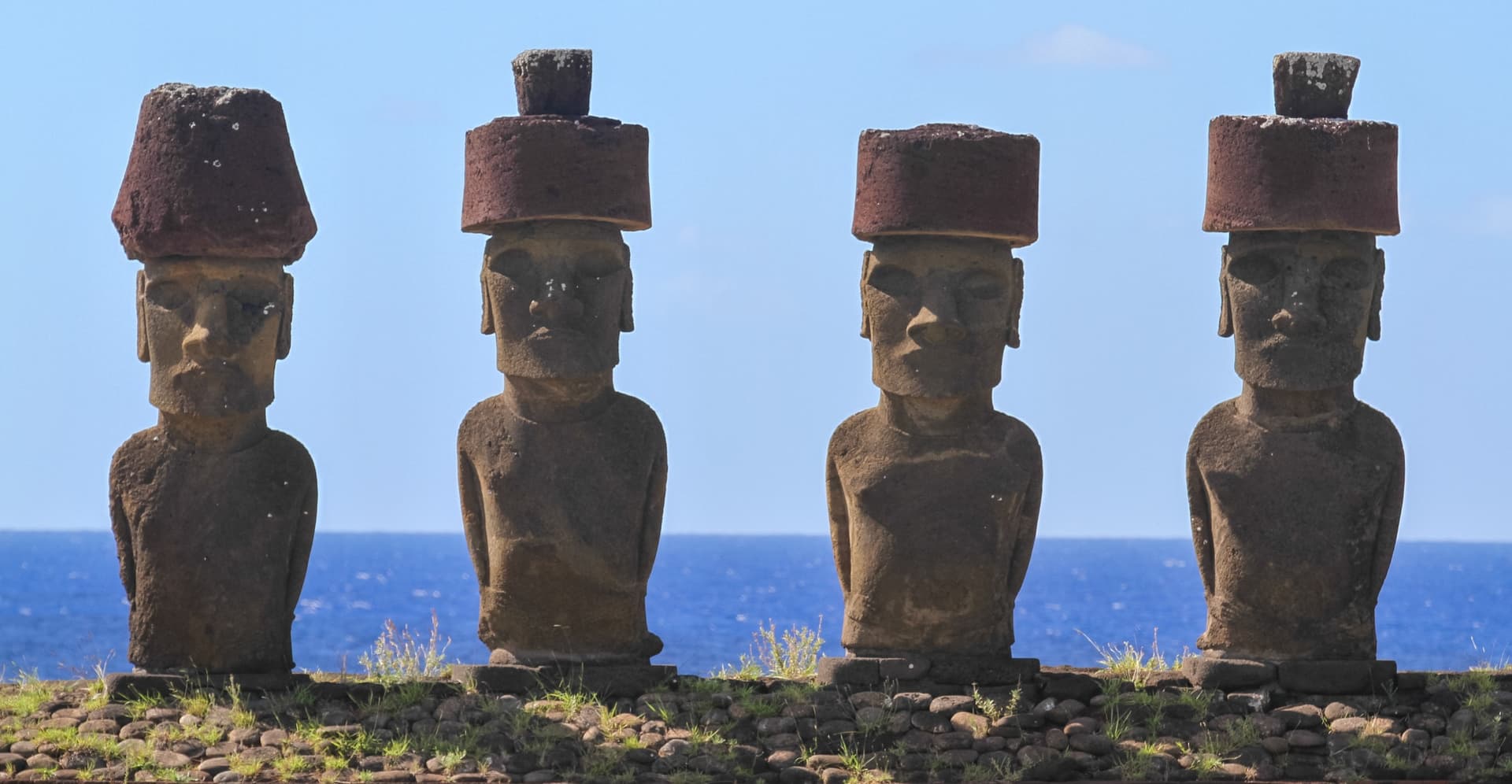
The moai are Easter Island's emblematic symbols—colossal monolithic statues carved with stylized human faces. Approximately 900 moai are scattered across the island. Some tower 1 to 20 meters high and weigh several dozen tons. Constructed between the 13th and 15th centuries by the island's ancient inhabitants, these figures likely represent venerated ancestors, offering spiritual protection and prosperity to local populations.
Most moai concentrate around the Rano Raraku volcanic quarry, where they were carved from volcanic stone. Their construction and transport remain mysterious, though theories suggest the use of wooden logs or sophisticated rocking techniques.
Moai typically stand on ceremonial platforms called ahu, which also served as burial sites and held profound significance in Rapa Nui culture. Many statues wear headdresses, sometimes called pukao, weighing over 10 tons—extracted from the red rock of Puna Pau volcano.
By Air
Most visitors begin by flying to Santiago, Chile's capital. From there, a direct flight to Easter Island awaits. LATAM Airlines is the primary carrier linking Santiago to the island, with flights taking approximately 5 hours and 30 minutes. Mataveri Airport (IPC) is the island's sole airport, located near Hanga Roa, the main town.
By Sea
Easter Island can be visited as a port of call on a 3-week cruise. Alternatively, travelers may board the Aquiles, a Chilean Navy vessel that sails twice yearly from Valparaiso to the island—a 7-day passage.
Easter Island Today
Easter Island has evolved into a sought-after destination, drawing thousands of visitors annually. Tourism provides vital income for residents. Rapa Nui National Park, covering much of the island, was established to protect its archaeological and natural sites. It was inscribed as a UNESCO World Heritage site in 1995.
Yet the island faces considerable challenges, including:
- Sustainable tourism management
- Moai conservation
- Preservation of Rapa Nui culture
Climate change poses an additional threat, accelerating coastal erosion and archaeological site deterioration.
Dialogue between local authorities and international organizations proves crucial in protecting and promoting Easter Island as a global treasure. The Rapa Nui community bears significant responsibility for island stewardship, ensuring traditions and heritage endure for future generations.
Public transport is absent on Easter Island. Visitors explore by hiking, horseback riding, or cycling. Alternatively, one can rent a vehicle—quad, motorcycle, scooter, or car—to traverse the island. Taxis serve remote sites, and organized excursions offer excellent ways to discover the island's unmissable wonders.
Attractions and Activities
To access all Easter Island sites, visitors must purchase a pass valid for 10 days, available at Mataveri Airport. Sites open from 8 a.m. to 8 p.m. and require a guide for entry.
In Hanga Roa, explore local markets, the church, and a small fishing port. The Museo Antropológico Padre Sebastián Englert chronicles the island's history through artifacts and archaeological treasures, including the sole female moai discovered around 1956. Information is available in English.
Caves and caverns—Ana Kakenga, Ana Te Pahu, and Ana Kai Tangata—merit a visit.
Orongo, an ancient ceremonial village perched on Rano Kau volcano's southern ridge, deserves exploration. This archaeological site holds roughly fifty stone structures and features petroglyphs. It was also a center for birdman cult worship.
Countless moai and ahu dot the landscape, including:
- Ahu Tahai
- Ahu Tongariki
- Ahu Vinapu
- Ahu Akivi
- Ahu Aka Hanga
- Ahu Nau Nau
- Ahu Vai Uri
- Ahu Hanga Hahave
The island's volcanic origins shape its character, marked by three extinct volcanoes: Maunga Terevaka, Puna Pau, Poike, and Rano Kau. The latter impresses with an immense crater now filled with freshwater lake, ringed by sheer cliffs. Visitors can summit these volcanoes for breathtaking vistas.
For relaxation, Anakena's white-sand beach beckons. Here, indulge in stand-up paddleboarding, scuba diving, and snorkeling in crystalline waters.
To immerse in local culture, time your visit with Tapati festival, an annual celebration of Rapa Nui traditions through dance, music, and sports competitions. Other festivities occur year-round, including the Pacific Arts Festival and Policarpo Toro Day.
Want to discover this destination?
Our local advisors design your tailor-made trip.