The Revash Mausoleums
The Revash Mausoleums
Clinging to a limestone cliff 60 km south of Chachapoyas, the Revash Mausoleums once housed the elite of the Chachapoyas culture between the 14th and 15th centuries.
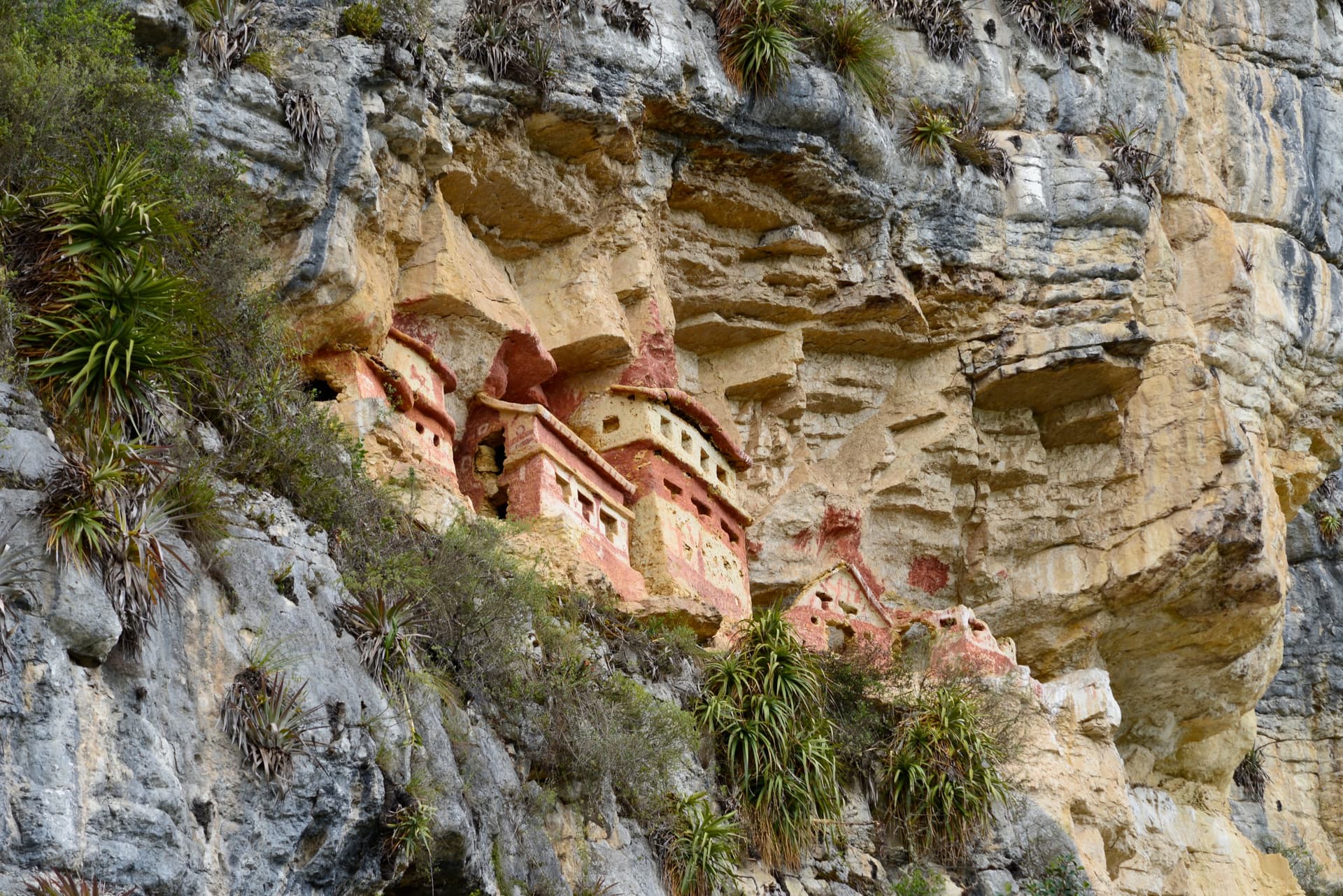
The Revash Mausoleums form a funerary site of the Chachapoyas culture (900 to 1450 AD), clinging to a limestone cliff of Cerro Carbón in northern Pérou. These small structures painted in red, aligned within a rocky cavity, once sheltered the mummified remains of the elite of this pre-Incan civilization.
Located 60 km south of Chachapoyas, at 2,800 meters altitude, the site demands respect: a walk of 1.5 to 4.5 km depending on where the vehicle drops you off leads to a viewpoint facing the mausoleums.
Why visit the Revash Mausoleums
- Unique funerary architecture: miniature stone and earthen houses, painted and decorated, designed to accommodate mummified bodies in a seated position.
- A spectacular setting: the limestone cliff overlooking the Río Utcubamba valley offers sweeping views across the eastern cordillera.
- A less-crowded site than Kuelap or Karajía, ideal for understanding Chachapoyas culture away from overtouristed circuits.
- An accessible hike combining archaeology and light trekking in mountain terrain.
History and rediscovery
The site was first documented in the late 19th century by Charles Wiener, an Austro-Hungarian explorer naturalized as French, during his Andean missions. However, it was only after the roof of a mausoleum collapsed that archaeologists Henry and Paule Reichlen undertook systematic study. Their work, around 1950, dated the structures to the 14th century.
The mausoleums belong to the architectural family of chullpas, pre-Incan funerary towers in stone or adobe scattered throughout the central Andes. Between 1983 and 1986, the Institute of Amazonian Archaeology conducted several expeditions in the zone corresponding to the Incan Anti Suyu, east of Cuzco. These campaigns enabled the identification of other nearby ensembles, notably the mausoleums of Ochín and the sarcophagi of La Petaca.
Most of the mummies have vanished: some looted over the centuries, others destroyed by rodents. The funerary objects recovered nonetheless confirm the elevated status of the deceased.
What you see on site
A cliff inhabited by the dead
Revash is located in Chachapoyas Province, Santo Tomás District, Amazonas Region. The limestone cliff in which the mausoleums are set overlooks the Río Utcubamba valley. The structures are arranged in two sectors aligned within a rocky cavity shaped like a narrow corridor, pressed against the rock face.
Miniature funerary houses
The foundations are stone, the walls are earthen. The mausoleums feature one or two levels, rising just over a meter in height, enough to place mummified bodies in a seated position. The façades face south, the entrances are lateral. The gabled roofs, in adobe reinforced with branches and reeds, play a symbolic role: it is the rocky overhang that truly protects the structures.
Colors and symbols
The ochre-red paint that covers parts of the walls is obtained from the seeds of achiote. The upper portions of the façades are decorated with painted moldings, depictions of felines, camelids (llamas), human figures, and bicolored circles.
Other motifs are incised into the earthen clay: concentric circles, T-shaped forms, rectangles. Their significance remains debated. The Andean cross (chakana or Cruz Andina), rendered in bas-relief, is associated with power and warfare, hence death. Concentric circles, by contrast, may evoke life and the world of the living.
Practical information
- Location: 60 km south of Chachapoyas, Santo Tomás District, Amazonas Region.
- Altitude: 2,800 meters.
- Effort: walk of 1.5 km (from San Bartolo) to 4.5 km depending on vehicle drop-off point, on rocky paths.
- Visit duration: allow half a day from Chachapoyas, including transport.
- What to bring: water, sun protection, hiking boots, windbreaker. The view is from a viewpoint; entry into the mausoleums is not permitted.
When to visit
The Chachapoyas region experiences two distinct seasons:
- Dry season, May to October: recommended period. Tracks are passable and skies generally clear.
- Wet season, November to April: frequent rainfall, roads sometimes impassable, muddy trails.
Annual temperatures range between 8°C and 18°C, with approximately twelve hours of daily sunshine. The wet season renders vegetation particularly lush but significantly complicates access.
How to get there
Reaching Chachapoyas from Lima
Two common routes from the capital:
- Via Tarapoto: flight Lima–Tarapoto, then combi (shared van) to Chachapoyas. Allow approximately 8 to 9 hours of driving.
- Via Jaén: flight Lima–Jaén, then bus to Chachapoyas, approximately 3.5 to 4 hours of driving.
From Chachapoyas to the mausoleums
From Chachapoyas, allow approximately 1 hour 30 minutes of driving to the village of San Bartolo. From there, a rocky trail leads in 1.5 km to the viewpoint over the mausoleums. For a longer hike, ask the driver to drop you 45 minutes before San Bartolo: you then complete a mini-trek of approximately 4.5 km.
Combining with nearby sites
Several major sites in the Amazonas region can be easily organized from Chachapoyas:
- Gocta Waterfall, one of Pérou's highest waterfalls, accessible via a rainforest hike.
- The sarcophagi of Karajía, other Chachapoyas tombs set into cliffsides.
- Kuelap Fortress, a vast pre-Incan fortified city perched above 3,000 meters.
To venture further south, other Andean landscapes merit a detour, such as Vinicunca near Cuzco or the Sacred Valley around Yucay.
Frequently asked questions
Frequently asked questions
No. The visit is conducted from a viewpoint situated opposite the cliff. The mausoleums are fragile and not directly accessible, which does nothing to diminish the visibility of the painted decorations.
The classic trail from San Bartolo is 1.5 km on rocky paths, accessible to anyone in reasonable physical condition. The altitude (2,800 m), however, requires acclimatization. The 4.5 km option adds elevation gain and remains moderate.
A day excursion is easily sufficient: approximately 1 hour 30 minutes driving each way, plus the hike and observation time on site. Most visitors combine Revash with another stop, such as the Leymebamba museum, which displays Chachapoyas mummies.
The pigment derives from achiote seeds, a plant used by many Andean and Amazonian cultures. Red is associated with blood and the world of the dead in pre-Incan cosmology.
They vanished over the centuries, victims of looting and rodents. Only the funerary buildings and a few fragments of offerings survive, studied by archaeologists.
Plan your trip
The Revash Mausoleums fit naturally into an itinerary across northern Pérou, between Kuelap, Gocta, and Karajía. To build a coherent circuit through the Peruvian Andes, consult our suggestions on travel to Pérou.
Interested in this visit?
We can include it in your personalised itinerary.