Basilica of San Francisco
Basilica of San Francisco
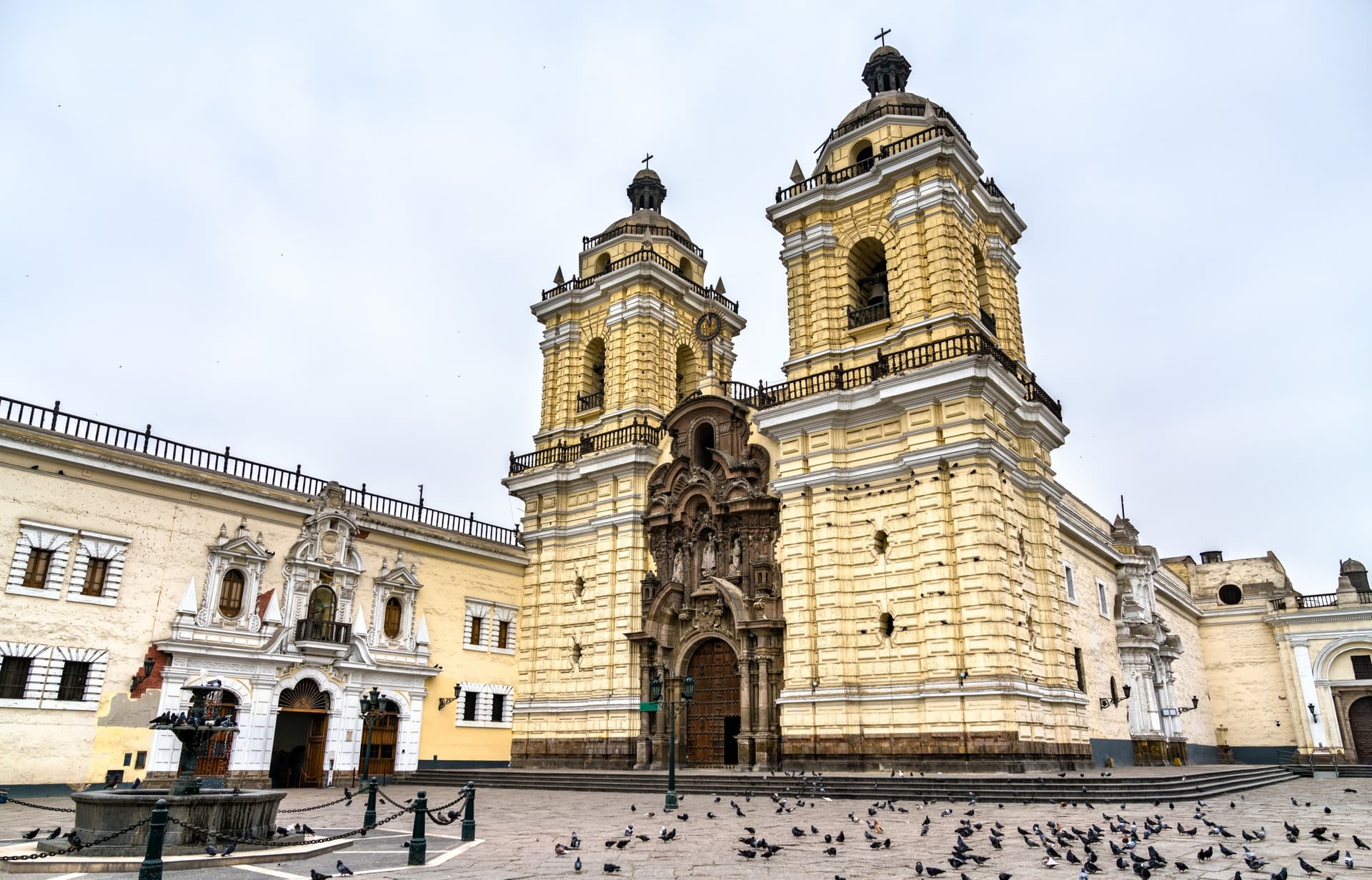
In the heart of Lima's historic center, the Basilica of San Francisco combines Baroque architecture, a colonial library, and catacombs sheltering 75,000 bodies.
In the heart of the historic center of Lima, the Basilica of San Francisco stands as one of Peru's best-preserved Baroque religious complexes from the colonial era. The complex groups a convent, a temple, two annexed churches (La Soledad and El Milagro), an ancient library, and an extensive network of catacombs.
Why visit the Basilica of San Francisco
The site's appeal lies in the rare combination of its components: Spanish Baroque architecture from the 17th century largely intact, a conventual library housing approximately 25,000 ancient texts, and underground catacombs sheltering nearly 75,000 bodies. The complex is part of Lima's Historic Center, inscribed as a UNESCO World Heritage site in 1991, making it an essential stop for understanding Lima during the vice-regal period.
History
Construction began in 1673 and was completed in 1774. Originally, the complex consisted of seven cloisters, an organization typical of large colonial Franciscan ensembles. The major earthquake of 1746, which devastated much of Lima, severely damaged the building. Reconstruction was undertaken by Brother Francisco de Borja, who restored the basilica to its current appearance.
In the 20th century, the widening of Avenida Abancay in the 1940s led to further modifications: expansions of certain parts of the monastery, repairs, and decorative campaigns. In 1991, Lima's Historic Center—to which the basilica belongs—was inscribed on UNESCO's World Heritage list.
What to see on site
The church and Baroque façade
The stone façade, framed by twin towers, exemplifies 17th-century Spanish Baroque. Inside, coffered Mudejar ceilings, gilded retables, and Seville tiles succeed one another in the nave and side chapels.
The cloisters and library
The cloisters preserve original tiles and a series of religious canvases from the schools of Lima and Cuzco. The conventual library houses approximately 25,000 ancient texts, some written shortly after the Spanish arrival in South America, making it a first-rate documentary resource for the colonial period.
The catacombs
Beneath the basilica extends a network of funerary galleries used until the early 19th century. Approximately 75,000 bodies are found here, their remains now arranged in geometric patterns. The guided tour represents the highlight of the underground journey.
The annexed churches
The complex includes two separate churches accessible from the forecourt: La Soledad and El Milagro, more modest but adorned with Baroque retables of interest.
Practical information
- Entry to the church is free; access to the convent, library, and catacombs is via a combined ticket at modest rates, with reductions for students and children.
- The convent is open daily, with a break mid-day for the basilica itself. Verify updated hours before your visit.
- Catacomb visits are guided and take place in groups, in Spanish and English.
- Allow 1 to 1.5 hours to explore the entire complex.
- Photography is often restricted inside the convent and prohibited in the catacombs.
Nearby
The basilica is located a few streets from Plaza Mayor, the government palace, and Lima's cathedral. The neighborhood concentrates most of the capital's colonial buildings: Santo Domingo convent, Casa de Aliaga, Torre Tagle palace. Half a day allows you to combine a visit to San Francisco with the main monuments of Lima's historic center.
How to get there
Lima is served by Jorge Chávez International Airport, located in the neighboring district of Callao, which concentrates the majority of the country's international and domestic flights. From the airport, the basilica is reached by taxi or tourist shuttles in 40 to 60 minutes depending on traffic.
Within Lima, the historic quarter is accessible by taxi, ride-sharing, or via the Metropolitano (BRT), Jirón de la Unión stop. Lima's railway station also hosts the seasonal service from Huancayo, in the central Andes, one of the few passenger trains still operating in Peru.
Frequently asked questions
Frequently asked questions
Allow 1 to 1.5 hours for the guided tour of the convent, library, and catacombs. Add 15 to 20 minutes if you wish to explore the church and two annexed chapels at your leisure.
Photography is generally prohibited in the catacombs and restricted in the library and rooms decorated with ancient canvases. The church is more permissive, but without flash.
The galleries are narrow, low-ceilinged, and feature irregular stairs. The visit is not recommended for people with reduced mobility or those prone to claustrophobia.
Advance booking is not mandatory for individual visitors, but it can be useful during high season (June–August) or to secure an English-speaking guided tour slot.
Include the basilica in your trip
The Basilica of San Francisco fits naturally into a stay in Lima at the beginning or end of a Peruvian itinerary. To build a customized trip combining the capital, the Andes, and Inca sites, explore our Peru travel ideas.
Interested in this visit?
We can include it in your personalised itinerary.