Ayacuchano Carnival of Lima
Ayacuchano Carnival of Lima
Each February-March, the Ayacucho diaspora recreates its traditional carnival in Lima: parades, Andean dances, colorful costumes and Huamanguina specialties.
The Ayacuchano Carnival of Lima is a festival of the diaspora originating from Ayacucho (formerly Huamanga), recreated each year in Peru's capital. During the months of February and March, the Santa Rosa complex, located between downtown Lima and the Rímac district, hosts parades, troupe competitions (comparsas), Andean music and gastronomy of Ayacuchan origin. It is one of the most visible regional carnival manifestations in Lima.
Why attend the Ayacuchano Carnival of Lima?
The Ayacuchano carnival ranks among Andean cultural expressions recognized as cultural heritage of Peru. In Lima, it takes on a particular dimension: the community originating from Ayacucho, settled in the capital following the displacements linked to the internal conflict of the 1980s-1990s, reproduces the festive codes of its region of origin. The event attracts both Ayacuchan families, curious Limeños and an audience of travelers interested in living Andean cultures, away from the classic circuits of colonial Lima.
Origins and history
Also called the Huamanguino carnival, this carnival finds its roots in a syncretism between Catholic festivities imported by the Spanish during the colonial era and pre-existing Andean celebrations linked to the fertility of the land and livestock. The Christian carnival calendar (preceding Lent) overlaid Quechua agrarian rites, giving rise to a celebration where Quechua chants, couples' dances, tinkuy contests and offerings to the Pachamama coexist with costumed parades.
Its transposition to Lima is more recent. With the massive urbanization of the twentieth century and the arrival of Andean migrants in the capital, regional associations (clubes departamentales) organized recreations of the carnival to maintain community bonds. The Santa Rosa complex is today one of the main gathering points of this tradition in Lima.
What to see and do on site
The comparsas and their costumes
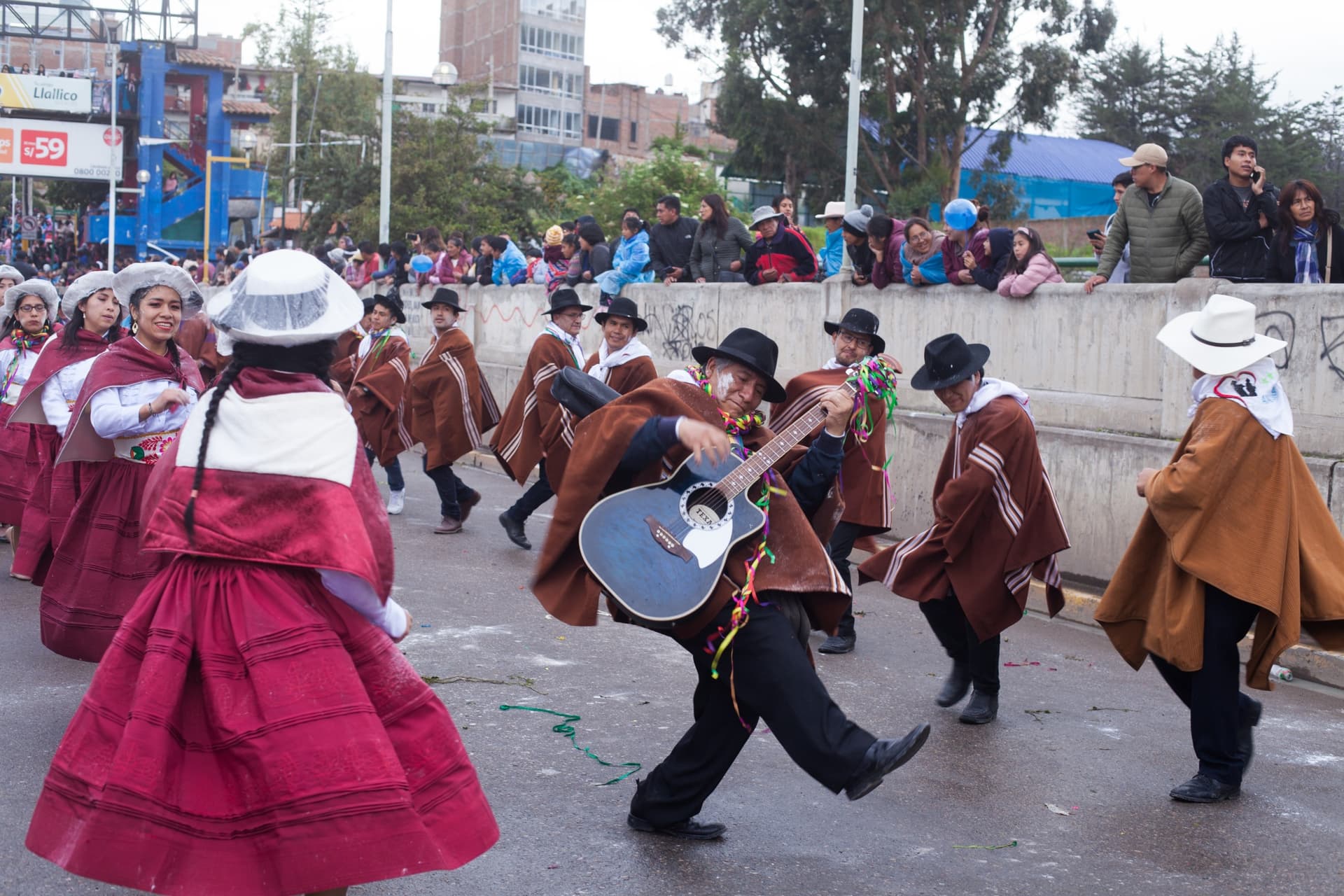
The troupes parade in groups representing provinces or districts of Ayacucho. The colorful costumes reproduce Huamanguina textile motifs: pleated skirts (polleras), embroidered shawls, hats adorned with flowers and ribbons. The men wear ponchos and ceremonial whips.
Andean music and dances
Typical instrumentation includes the quena, the charango, the mandolin, the tinya (small drum) and the accordion. The repertoire combines carnival huaynos and pumpín, a couples' dance emblematic of southern Ayacucho. The songs are predominantly in Quechua.
Ayacuchan gastronomy
Several stands offer regional specialties:
- Chicha de jora, a fermented drink made from corn
- Puka picante, a red stew based on beets, peanuts and pork or beef
- Mondongo Ayacuchano (tripe and corn soup)
- Qapchi, a sauce made with fresh cheese and chili pepper
Evening dances
In the evening, the arena transforms into a collective dance floor. Invited groups chain their sets and the public, mixed with costumed dancers, extends the celebration late into the night.
When to go?
The Ayacuchano carnival follows the Catholic liturgical calendar: it takes place the weeks preceding Ash Wednesday, that is in February or early March depending on the year. In Lima, associations typically schedule several consecutive weekends at the Santa Rosa complex, with peak attendance on the main carnival weekend. This period corresponds to the hot and humid season in Lima: plan for light clothing and protection from possible rain showers.
Practical information
- Location: Santa Rosa complex, at the boundary between the districts of Cercado de Lima and Rímac
- Access: taxi or ride-hailing apps from the historic center (10-15 minutes depending on traffic); urban buses from Avenida Tacna
- Admission: modest paid entry fee to the event, tickets available on-site or through organizing associations
- Duration: plan for a half-day to a full day to enjoy the parades, competitions and evening dance
- To bring: cash (soles), camera, comfortable clothing
The atmosphere remains primarily communal: respectful behavior towards the troupes and their rituals is expected, particularly during ceremonial sequences.
What to see nearby
The carnival is part of a stay in Lima, whose historic center, the neighborhoods of Barranco and Miraflores and pre-Columbian archaeological sites deserve several days. To extend the immersion into Andean cultures, you can combine it with the City of Caral north of Lima, or plan a stop towards the Cusco region to visit the ruins of Ollantaytambo and the site of Q'enko.
Frequently asked questions
Frequently asked questions
Integrating the carnival into a Peru trip
Scheduling your stay around the Ayacuchano carnival allows you to approach Lima through its Andean and migratory dimension, often absent from classic circuits. To build a tailor-made itinerary including Lima, Cusco, Machu Picchu or the southern coast, consult our Peru trips.
Interested in this visit?
We can include it in your personalised itinerary.