Nazca Lines Overflight
Nazca Lines Overflight
Ancient geoglyphs inscribed on UNESCO's World Heritage List, the Nazca Lines are discovered during an overflight in a small aircraft above the Peruvian desert.
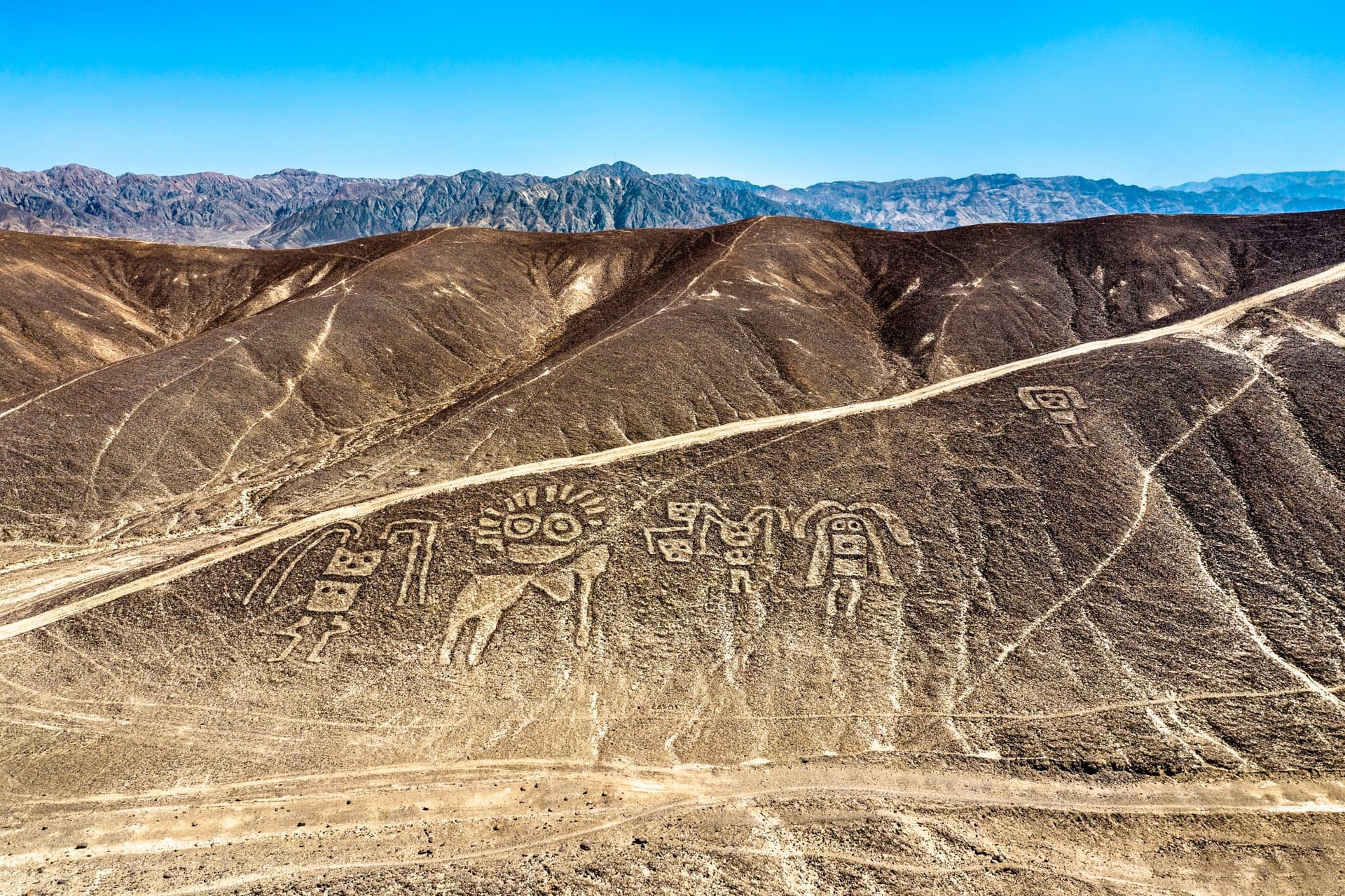
Traced on the stony floor of the Peruvian desert more than two thousand years ago, the Nazca Lines comprise hundreds of geometric, animal and plant figures visible only from the air or from a few high vantage points. Inscribed on the UNESCO World Heritage List in 1994, this enigmatic site is usually visited during an overflight in a small aircraft departing from the city of Nazca, 450 km south of Lima.
Why visit the Nazca Lines
The geoglyphs of Nazca represent one of South America's great archaeological mysteries. Created by the Nazca civilization, which predated the Incas, between 200 BC and 600 AD, they have remained intact for more than two thousand years thanks to exceptionally arid and stable climate conditions. More than 800 geometric geoglyphs and 70 biomorphic figures have been recorded to date, including the monkey, hummingbird, spider, condor, killer whale, heron and the silhouette known as the "astronaut". To see them, you must gain altitude: it is this brief but striking aerial experience that makes a detour to the Ica region worthwhile.
History and Scientific Discoveries
The lines were identified in 1927 by Peruvian archaeologist Toribio Mejía Xesspe, who first spotted them from the surrounding hills. It was not until 1939 and the first aerial photographs by American researcher Paul Kosok that their true scale was understood. Kosok then formulated a hypothesis that would become famous: the geoglyphs would form "the world's largest astronomy book". German mathematician Maria Reiche, who devoted her life to their study, pursued this line of inquiry, seeing them as a vast astronomical calendar.
UNESCO World Heritage inscription came in 1994 and covers the Nazca and Palpa complexes. From 2004 onwards, Professor Masato Sakai of Yamagata University has led a Japanese team that has multiplied discoveries: about a hundred geometric geoglyphs in 2006, a 4m by 3m human head and a 7m by 3m animal in January 2011, then two human figures and 17 animals measuring 5 to 10m in 2013. The team established a permanent laboratory on site, the Nazca Institute. More than 350 representations have been studied to date.
What You See from the Air
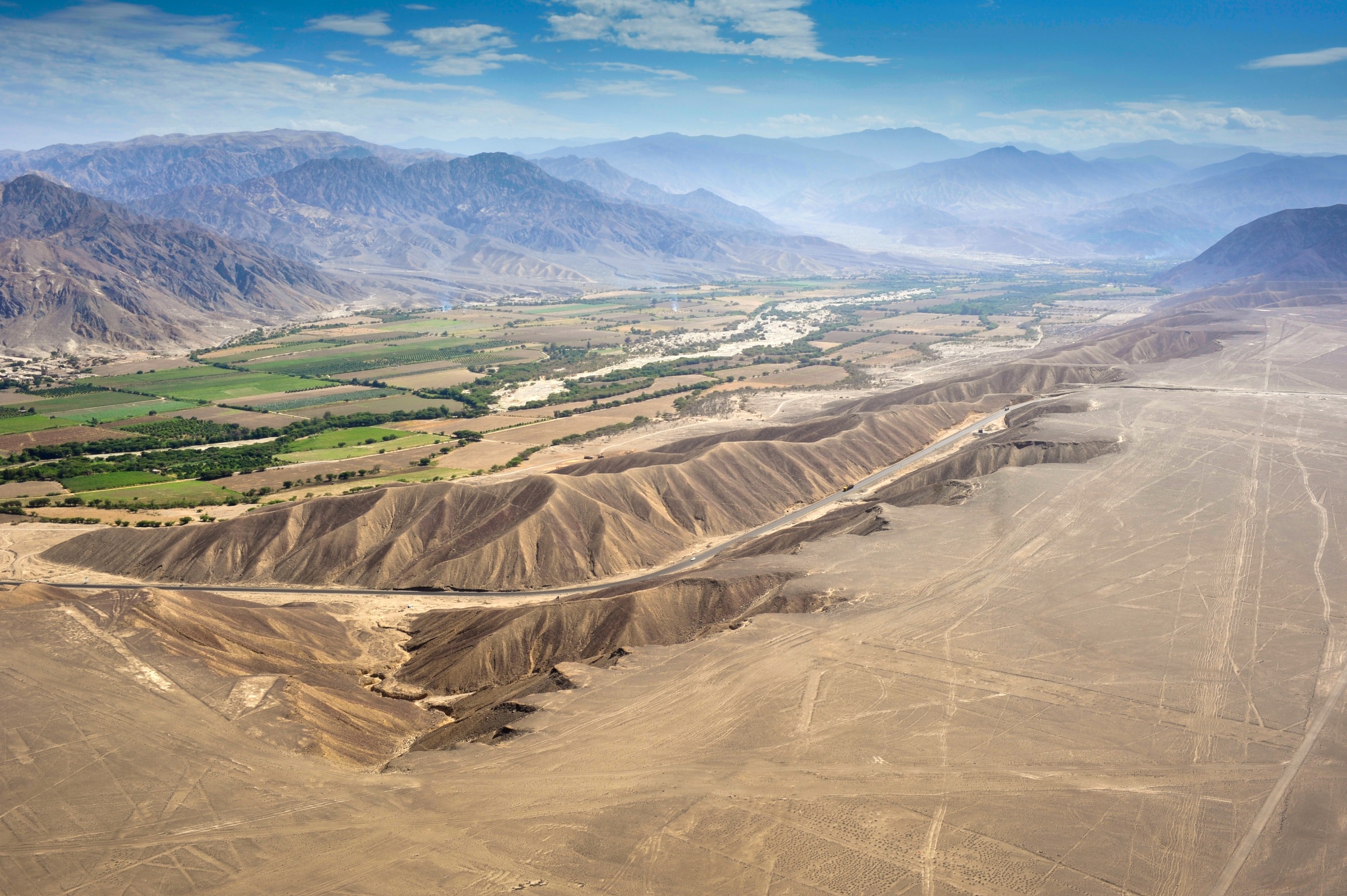
The figures extend across an area of approximately 750 km², along a 50 km band linking Nazca to Palpa. Their lengths vary from 50 to 300 meters. Two main families can be distinguished:
- Geometric geoglyphs: straight lines, spirals, ellipses, trapezoids, triangles. The most numerous, with about 800 recorded.
- Biomorphic figures: about sixty stylized animals and plants, including the monkey, jaguar, spider, hummingbird, condor, pelican, killer whale, heron, as well as a tree and the famous anthropomorphic silhouette nicknamed the astronaut.
The Nazca people are believed to have used a grid technique (gridding) to transfer motifs at large scale. By removing the top layer of rocks reddened by iron oxide, they revealed a lighter greyish gypsum subsoil, creating a lasting contrast. The site's preservation owes to exceptional conditions: 30 mm of annual rainfall, a layer of hot air that dampens ground-level winds, and gypsum that retains sand. An incident in January 2018, when a semi-trailer left ruts over a hundred meters, highlighted the fragility of this balance.
What Do These Drawings Mean
No single theory enjoys universal agreement. The main scientific hypotheses are as follows:
- Astronomical calendar: Paul Kosok and later Maria Reiche argued that the lines aligned with points of sunrise or sunset for celestial bodies.
- Shamanistic ritual sites: the figures, visible from the sky, were intended for deities. Nazca pottery reproduces the same motifs, suggesting an animal pantheon and processional pathways.
- Hydraulic markers: an Italian team proposed that certain lines mark underground water sources and the course of aqueducts, vital in this desert region.
- Ancient astronaut theory: popularized outside academic circles, it sees the figures as an extraterrestrial landing strip. It is not accepted by researchers.
Practical Information for the Overflight
The overflight takes place in a single-engine four-seater Cessna departing from Nazca airfield. Allow approximately 30 minutes of flight time, during which the aircraft banks its wings over a dozen main figures to allow each passenger to view them. Air sickness is common due to tight turns; a light breakfast is recommended. Prioritize morning time slots, when air conditions are more stable, and plan flexibility into your itinerary in case weather forces a postponement.
For travelers who prefer not to fly, a viewpoint located 20 km north of Nazca on the Panamericana allows you to spot three figures from an observation tower: the tree, the hands and the lizard. A local bus heading north will drop you off on request.
When to Go
The period from May to September offers the most stable conditions, with temperatures of 19 to 21 °C and clear skies conducive to flights. October and January may experience occasional rainfall episodes that could delay or cancel an overflight. Outside these periods, flights are generally possible but visibility varies.
How to Get There
Nazca is located approximately 450 km south of Lima on the Panamericana. Several options:
- From Lima: long-distance buses by day or night, approximately 7 hours' travel time.
- From Ica or Huacachina: approximately 3 hours by bus, the most common option for travelers combining the oasis and the lines.
- Scenic flight: some operators offer round-trip flights from Pisco or Ica, but the experience is shorter and more expensive.
What Else to See in the Region
The Ica region and southern Peru allow you to extend your visit with other major sites. Travelers often continue toward Salinas and Aguada Blanca in the Arequipa region, or head back north to the Andes to discover the Tinajani Canyon. Further north, in the sacred valley of the Incas, Yucay and the ceremonial site of Tambomachay deserve a stop, as does the seven-colored mountain Vinicunca.
Frequently Asked Questions
Frequently asked questions
Plan Your Trip
The Nazca Lines naturally integrate into an itinerary combining the south coast, the sacred valley and Machu Picchu. To build a custom-tailored journey, consult our Peru travel ideas.
Interested in this visit?
We can include it in your personalised itinerary.