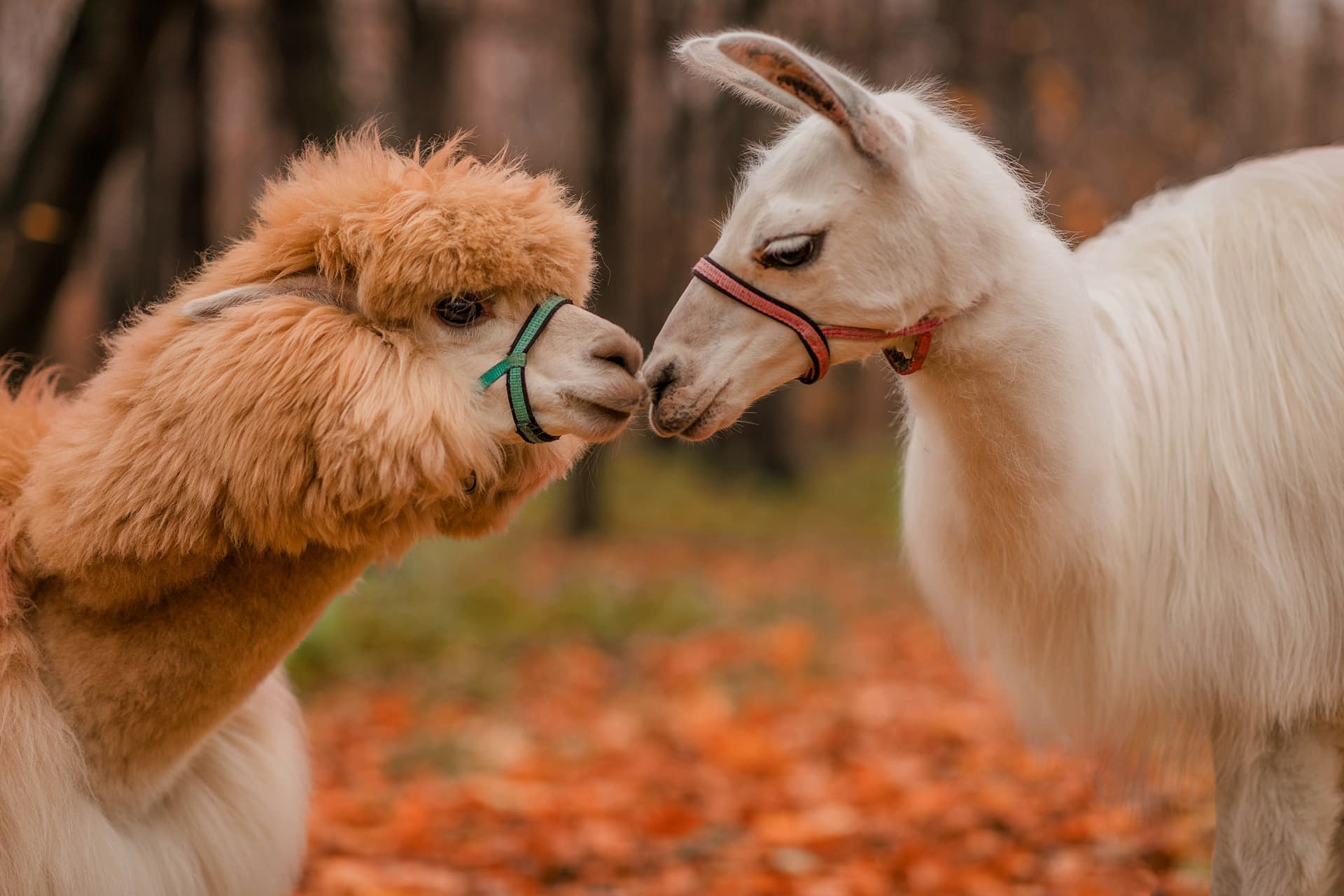
Llamas and Alpacas: How to Tell Them Apart?
Planning to explore the South American Andes? It's time to learn the difference between llamas and alpacas, these two charming herbivorous camelids you'll undoubtedly encounter at altitude, on the high plateaus of Peru's Altiplano… Discover their origins and how to distinguish them during your Pérou journey!
In Which Regions Do Llamas and Alpacas Live?

Both llamas and alpacas are native to South America but live in different habitats. While llamas originate from the high Andes plateaus (and live at approximately 4,000 meters altitude), alpacas are native to the mountainous regions of Bolivia, Chile, and Pérou (at 5,000 meters altitude).
Llamas are raised for two primary reasons: besides providing invaluable assistance to herders (as highly effective "pack animals" employed to carry heavy loads), they produce wool highly sought after by the textile industry.
The alpaca, on the other hand, is raised exclusively for its ultra-soft wool – equally prized by the textile industry (and the luxury market in particular). Among the four species of camelids found in South American territories: llamas and alpacas are the only two that are fully domesticated – having been tamed for centuries!
What Is the Difference Between a Llama and an Alpaca?
These two charming creatures of the Andes cordillera are camelids. More specifically, animals from the family Artiodactyla – hoofed mammals with an even number of toes (as are also dromedaries and camels).
Though they resemble each other greatly, llamas and alpacas do present physical differences that make them easy to distinguish, once you know their distinguishing characteristics!
The Physical Appearance of These Two Camelids

The llama and alpaca have somewhat different family trees. While the former are cousins of the guanaco, the latter are related to the vicuña – two other camelids, but wild ones.
Build
The main distinction between the two animals is evident first in their build. Reaching heights of up to 1.9 meters and weights of 200 kilograms, the llama is the most imposing camelid. Thanks to its size, it can carry approximately 40 kilograms of load on its back!
The alpaca, meanwhile, has a somewhat less imposing build, with a height rarely exceeding 90 centimeters (except for some animals that may reach 1.20 meters) and an average weight of 80 kilograms. Unlike the llama, the alpaca does not serve as a pack animal. Why? It has a back with a very inclined pelvis angle, which prevents it from carrying loads…
Ears

Due to their origins, their anatomy presents some differences that allow you to tell them apart. The most subtle? The shape of the ears! Rather long and curved forward for llamas, those of alpacas are more rounded and shorter.
Teeth
While a llama's teeth are fully developed by age five, an alpaca's incisors continue to grow throughout its entire life! As a result, they must be regularly filed down by herders!
Behavior
Though both live in community within a herd, the llama and alpaca each have their own distinct personality!
The Llama: The Most Independent
Renowned for its intelligence, the llama proves to be a highly effective working companion. Quite close to humans (having been educated for centuries), it allows itself to be easily handled. Brushing, shearing, harnessing, carrying: it will cooperate… once you've won it over! Indeed, the llama is renowned for its strong character and stubborn streak, which requires a little time for approach and building trust. Nevertheless, it is a discreet and curious animal that enjoys being petted.
The Alpaca: The Gentlest

Though naturally calm, the alpaca dislikes… solitude! To thrive, it needs to belong to a herd, to live contentedly among its own. Gentler than the llama (in both senses – personality and coat) – the alpaca is nevertheless shyer than the llama; extremely kind and docile.
|
Worth Noting Contrary to popular belief (popularized by Captain Haddock...), a llama doesn't spend its time spitting at people! Spitting is mainly a defense mechanism for a llama, allowing it to ward off the object of its anger. Similarly, it's even rarer to see an alpaca spit (and if it happens, it's typically directed at one of its herd mates rather than at a human). |
Coat
While wool is the main point in common between the two species, it too has a few differences…
Llama Wool: The Warmest
Thicker than alpaca wool, llama wool is also the warmest. There are several types of llamas. Among them: the llama wool (prized for its abundant wool and curly hairs) and the llama silky (renowned for the high quality of its soft, lustrous wool).
Alpaca Wool: The Softest
Softer than llama wool, alpaca wool is recommended for sensitive skin (its fiber is indeed considered among the finest and softest in the world). Its delicacy, its numerous hues, and its excellent thermal properties make alpaca wool a rare material, highly coveted by the luxury industry.
What Is a Baby Alpaca Called?

The offspring of a female (hembra) alpaca and a male (macho) is called a cria. This is derived from the Spanish verb criar, which means "to raise." A female gives birth to only a single baby per year.
What Is Llama Wool Called?
Llama wool doesn't have a specific dedicated name, but is often associated with "alpaca wool," due to the resemblance between the two animals. Llama wool is slightly thicker than alpaca wool, and therefore warmer.
What Is the Llama's Cousin?
The llama's cousin is the guanaco. It is a wild camelid, unlike the llama which is considered a domesticated animal!
Audrey Denjean